Cosmic Nurseries: The Fascinating Scientific Journey of How a Planet is Born
A ciência da formação de planetas explora os mistérios de como mundos tomam forma no vasto cosmos, revelando processos surpreendentes.
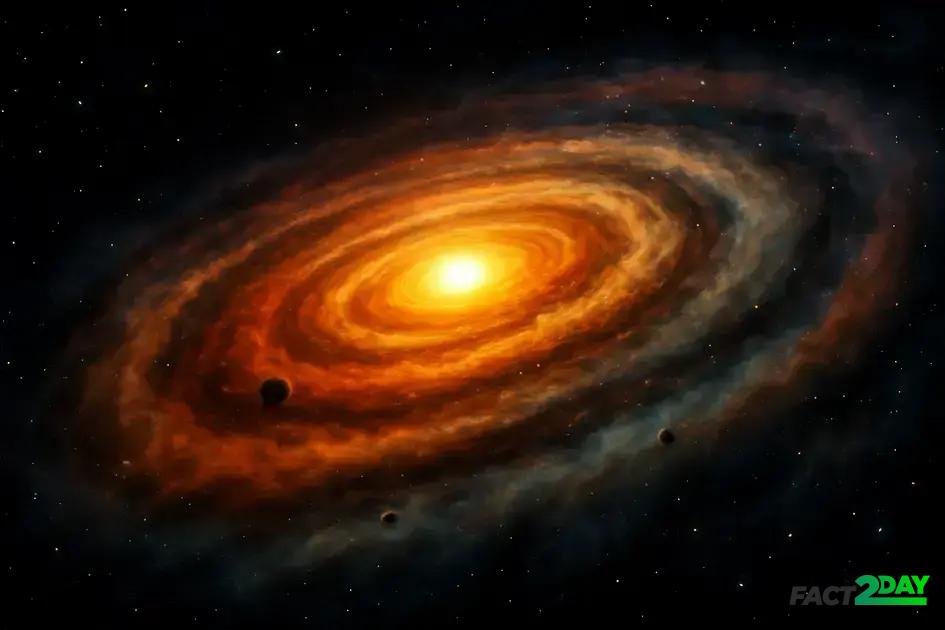
The science of planet formation studies how gas and dust clouds collapse under gravity to form protoplanetary disks where particles coalesce into solid planets through accretion and gravitational interactions.
The science of planet formation invites us to look to the sky and imagine the delicate cosmic ballet that creates new worlds. Have you ever wondered how a planet takes shape from the primordial chaos of the universe? Let’s explore these celestial nurseries together, where the complexity and beauty of the cosmos are revealed.
The role of gas and dust clouds in the creation of planets
In the vastness of space, clouds of gas and dust are the essential building blocks for planet formation. These massive interstellar clouds, called molecular clouds, are cold and dense, providing the perfect environment for gravity to act. Over time, parts of these clouds begin to collapse under their own gravitational pull.
As the cloud collapses, it forms a spinning disk of material around a new star, known as a protoplanetary disk. This disk contains dust particles and gas, which slowly stick together through a process called accretion. Tiny dust grains collide and merge, creating larger clumps that eventually grow into planetesimals, the seeds of planets.
The importance of dust and gas composition
The type of dust and gas present in these clouds can influence what kind of planets will form. For instance, clouds rich in heavier elements tend to create rocky, terrestrial planets, while those dominated by lighter gases can give rise to gas giants.
The interactions within these clouds, including turbulence and magnetic fields, also affect how efficiently material coalesces and the size of the resulting planets. Understanding these processes is crucial as they lay the foundation for the entire planetary system.
How Protoplanetary Disks Evolve into Solid Planets
Protoplanetary disks are the swirling disks of gas and dust surrounding young stars. These disks serve as the birthplace of planets, where dust particles slowly stick together to form larger bodies. The process starts with tiny grains colliding and clumping into larger aggregates called planetesimals.
Growth from dust to solid bodies
Over time, these planetesimals attract more material due to gravity, growing into protoplanets. This phase involves complex interactions, including collisions and mergers, which help shape the planets. Gas in the disk plays a crucial role by providing the environment where solids can accumulate and by influencing the disks’ temperature and chemistry.
Disk evolution also causes material to migrate inward or outward, affecting where and how planets form. The disk gradually dissipates as material is absorbed into planets, blown away by stellar winds, or accreted by the star itself. This evolution marks the transition from a dusty disk to a mature planetary system with solid planets.
The influence of gravitational forces on planetary formation
Gravitational forces play a key role in shaping how planets form within a protoplanetary disk. Starting from tiny dust particles, gravity causes these materials to clump and grow, eventually leading to larger bodies called planetesimals. As these objects grow, their gravitational pull becomes stronger, drawing in more material and accelerating their growth.
Gravity as the architect of planetary systems
Beyond simple clumping, gravity affects the overall dynamics of the disk. It governs how matter moves, creating gaps, spirals, and rings within the disk. These patterns can influence where planets can form and migrate.
Gravitational interactions among forming planets can cause them to shift or even collide, altering their orbits and compositions. This constant gravitational tug-of-war shapes the final layout of planetary systems, including our own.
Understanding the journey of planet formation
The process of planet formation is a fascinating dance of gas, dust, and gravity working together in space. From tiny particles in clouds to solid worlds, each step shapes the planets we know and discover.
By studying these cosmic processes, scientists gain insight into how our own Earth was formed and where other planets might exist. This knowledge deepens our appreciation of the universe’s complexity and beauty.
Exploring the science behind planet formation opens windows to new discoveries and expands our understanding of the cosmos.