Oases in the Abyss: The Bizarre and Resilient Ecosystems Thriving Around Deep-Sea Hydrothermal Vents
Explore Deep Sea Hydrothermal Vent Life and uncover bizarre ecosystems thriving in extreme oceanic environments, revealing nature's resilient marvels.
Imagine a courtroom where the defendant isn’t human but an animal. This strange scene was actually common in medieval Europe, where animals faced legal trials. Pigs were accused of murder, beetles of destroying crops, and many animals were given lawyers and witnesses just like humans.
These trials show how people of that time saw animals not just as property, but as beings who could be held responsible for their actions. It reflects a world where law, religion, and morality were deeply connected, and even animals were part of this complex system.
Though this practice seems odd today, it reveals how ideas about justice and responsibility have changed. It also makes us think about how laws and concepts of fairness evolve over time, sometimes in surprising ways.
Consider for a moment the Deep Sea Hydrothermal Vent Life—a realm where bizarre ecosystems thrive against all odds in the ocean’s depths. What secrets do these oases hold, and how do such resilient life forms survive the abyss?
The discovery and significance of deep-sea hydrothermal vents
Deep-sea hydrothermal vents were discovered unexpectedly in 1977, deep in the Pacific Ocean near the Galápagos Islands. These vents are fissures on the ocean floor where heated, mineral-rich water streams out from beneath the Earth’s crust. Their discovery changed our understanding of life on Earth because, unlike typical ecosystems that depend on sunlight, vent communities rely on chemical energy.
The significance of these vents lies in their ability to support unique ecosystems that thrive in complete darkness, extreme pressure, and high temperatures. Scientists found entire communities of organisms, such as tube worms, clams, and bacteria, living there. These ecosystems showed that life can exist in harsh environments previously thought uninhabitable.
Moreover, hydrothermal vents are crucial for studying the origins of life and the possibility of life on other planets. The vents provide clues about how life might survive in extreme conditions elsewhere in the solar system. They also play a role in Earth’s global chemical cycles, releasing minerals and gases that affect ocean chemistry.
Since their discovery, deep-sea hydrothermal vents have become a hotspot for marine biology, geology, and chemistry research. They remind us how much there is still to learn about our planet’s hidden depths and the incredible adaptability of life.
Unique chemical environments fueling vent ecosystems
Deep-sea hydrothermal vents create a unique chemical environment unlike any other place on Earth. These vents release superheated water rich in minerals like hydrogen sulfide, methane, and various metals, all under intense pressure and darkness. This chemical-rich water mixes with the cold ocean water, creating gradients that provide energy for specialized microorganisms.
Chemosynthesis: The Foundation of Vent Life
Instead of relying on sunlight, vent ecosystems depend on chemosynthesis. Bacteria and archaea oxidize chemicals such as hydrogen sulfide to produce energy, forming the base of the food web. These microbes support larger organisms like tube worms and clams, which often host symbiotic bacteria inside their bodies.
The vent chemistry varies by location, which influences the types of species present and their adaptations. For example, high levels of metals can be toxic, but many vent organisms have evolved mechanisms to tolerate or utilize these elements. The unique chemistry also drives mineral deposition around the vents, shaping the physical environment.
Understanding these chemical environments is vital for comprehending how life sustains itself in such extreme settings and offers clues about the resilience and adaptability of organisms living there.
Key species adapted to hydrothermal vent life
Hydrothermal vents host a variety of species uniquely adapted to survive in extreme conditions like high pressure, darkness, and toxic chemicals. These species form complex communities around the vents, relying on each other and specialized biochemical processes.
Tube worms: The iconic vent inhabitants
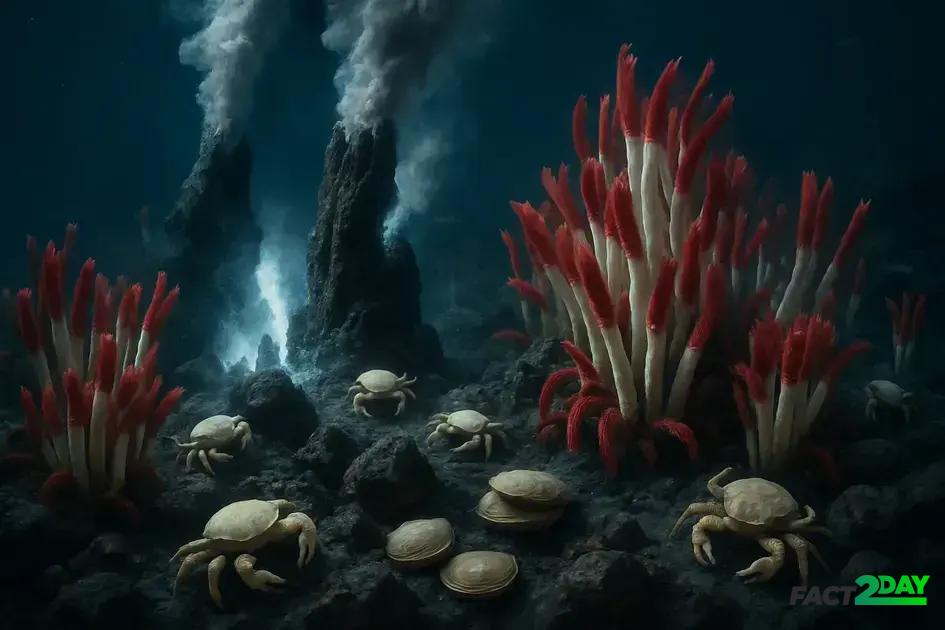
Tube worms (Riftia pachyptila) are some of the most striking vent animals. They have no digestive system and instead rely on symbiotic bacteria living inside their bodies to convert chemicals from vent fluids into energy, a process known as chemosynthesis. Tube worms can grow several feet tall and create dense colonies around vents.
Vent crabs and shrimp
Various species of crabs and shrimp scurry across the vent fields, scavenging debris, preying on other animals, or farming bacteria. They often have adaptations that protect them from toxic chemicals and fluctuations in temperature.
Clams and mussels with symbiotic bacteria
Clams and mussels in these ecosystems also host chemosynthetic bacteria inside their gills. This relationship allows them to thrive where food is scarce and survive by harnessing the chemical energy released by the vents.
Other species include vent fishes, anemones, and specialized microbes that form mats on surrounding surfaces. Each species plays a role in sustaining the delicate balance of these oases deep under the ocean.
Symbiotic relationships and chemosynthesis explained
Many organisms around deep-sea hydrothermal vents live in symbiotic relationships, relying on each other to survive in an environment without sunlight. At the core of these relationships is chemosynthesis, a process where certain bacteria convert chemicals like hydrogen sulfide from the vent fluids into energy.
Chemosynthetic bacteria as primary producers
Unlike plants that use photosynthesis, these bacteria use chemical energy to produce organic matter. They form the base of the food web in vent ecosystems, supporting a variety of animals.
Symbiosis in tube worms and clams
Organisms such as tube worms and clams host chemosynthetic bacteria inside their bodies. These bacteria live in their tissues, providing nutrients in exchange for shelter and access to vent chemicals. This allows the host animals to thrive where food is otherwise scarce.
Mutual benefits and adaptation
Such symbiotic partnerships are essential for survival in extreme vent environments. They demonstrate remarkable adaptation, enabling complex communities to flourish in darkness, under extreme pressure, and amid toxic chemicals.
These relationships highlight the diversity of life strategies on Earth and inspire study about life’s possibilities beyond our planet.
How vent communities resist extreme pressure and temperature
Vent communities survive in one of the most extreme environments on Earth, where pressures exceed 250 times the atmospheric pressure at sea level and temperatures can range from near freezing to over 400°C near vent openings. These harsh conditions require special adaptations.
Adaptations to high pressure
Many vent organisms have flexible cell membranes and specialized proteins that maintain function under intense pressure. These adaptations prevent cellular damage and ensure biological processes continue without interruption.
Temperature tolerance and behavior
Some species, like certain tube worms and bacteria, live very close to hot vent fluids, enduring rapid temperature changes. They regulate their position to avoid lethal heat while benefiting from the energy-rich environment. Others have enzymes that remain stable and active at higher temperatures.
Heat shock proteins help protect cells from thermal damage by repairing proteins that unfold due to heat stress. This molecular defense is critical for survival in fluctuating temperatures near vents.
Structural adaptations
Exoskeletons in vent crustaceans and mineralized tissues in tube worms provide protection against both pressure and chemical toxicity. Additionally, vent species often have slow metabolisms and energy-efficient processes suited for extreme environments.
These adaptations showcase nature’s resilience, allowing diverse life to thrive in hostile, deep-sea habitats.
The role of deep-sea vents in global biochemical cycles
Deep-sea hydrothermal vents play a vital role in global biochemical cycles by releasing minerals and chemicals that influence ocean chemistry and, ultimately, Earth’s climate. These vents emit large amounts of elements like sulfur, iron, and manganese into the surrounding waters.
Impact on sulfur and carbon cycles
The chemical compounds released, particularly hydrogen sulfide, fuel chemosynthetic bacteria that fix carbon dioxide into organic matter. This process links vents to the global carbon cycle by creating biomass independent of sunlight.
Additionally, vents contribute to the sulfur cycle, where sulfur compounds released into the ocean undergo chemical transformations, affecting marine ecosystems and atmospheric chemistry.
Mineral deposition and nutrient cycling
Hydrothermal vents deposit minerals that can settle on the seafloor or dissolve, impacting nutrient availability. These minerals enrich ocean waters with trace elements crucial for many marine life forms far from the vent sites.
Influence on ocean chemistry and climate
The chemical reactions at vents can influence ocean acidity and nutrient distribution, which in turn affect marine food webs and carbon sequestration. Understanding these processes helps scientists grasp how deep-sea vents connect to larger Earth systems.
The study of deep-sea hydrothermal vents enhances our knowledge of Earth’s complex biochemical balance and highlights their importance beyond being biodiversity hotspots.
Technological advances in exploring hydrothermal vents
Technological advances have greatly improved our ability to explore and study deep-sea hydrothermal vents. Initially, these vents were discovered using basic deep-sea submersibles, but modern technology now allows for more detailed and prolonged exploration.
Remotely operated vehicles (ROVs) and autonomous underwater vehicles (AUVs)
ROVs and AUVs are key tools for exploring vents. They can dive to extreme depths and stay submerged for hours, capturing high-resolution images and collecting samples without risking human divers. These vehicles are equipped with robotic arms and sensors to study the fragile vent ecosystems.
Advanced imaging and sensors
Modern equipment uses sonar mapping, 3D imaging, and chemical sensors to detect mineral-rich plumes and map the ocean floor. These tools help identify active vent sites and monitor changes over time.
In situ experiments and long-term monitoring
New technologies allow scientists to perform experiments directly at vent sites and install instruments that continuously collect data on temperature, chemistry, and biological activity. This provides insights into how vent ecosystems respond to environmental shifts.
Such advances have expanded our understanding of vent ecosystems, revealing their complexity and resilience while informing conservation efforts in these remote, extreme habitats.
Threats facing vent ecosystems and conservation efforts
Deep-sea hydrothermal vent ecosystems face several threats despite their remote locations. Human activities and environmental changes put these unique habitats at risk.
Impact of deep-sea mining
Deep-sea mining targets mineral-rich deposits around vents, risking habitat destruction and disruption of fragile communities. Mining machines can irreversibly damage vent structures and reduce biodiversity.
Climate change and ocean acidification
Rising ocean temperatures and acidification affect vent chemistry and species survival. These changes can alter symbiotic relationships and reduce the resilience of vent organisms.
Pollution risks
Pollutants from surface activities may reach deep-sea vents, introducing toxins that disrupt biological processes. Increased plastic and chemical waste threaten the health of vent species.
Conservation efforts
Scientists and policymakers are working to protect vent ecosystems through marine protected areas and regulations on mining activities. Monitoring and research support informed decision-making and highlight the vents’ ecological value.
Greater awareness of these threats is crucial for preserving the bizarre and resilient ecosystems that thrive around deep-sea hydrothermal vents.
Parallels between vent life and potential extraterrestrial ecosystems
Scientists often look to deep-sea hydrothermal vent ecosystems as models for understanding potential life beyond Earth. These vents demonstrate how life can thrive without sunlight, using chemical energy instead, which widens the scope of possible habitats in the universe.
Life without sunlight
Vent ecosystems rely on chemosynthesis, where bacteria convert chemicals like hydrogen sulfide into energy. This ability shows that life can exist in total darkness, a valuable insight when considering habitats on moons or planets without sunlight.
Extreme environment survival
Organisms at vents endure extreme pressure, temperature changes, and toxic chemicals. Studying their adaptations helps astrobiologists imagine how life might survive harsh conditions on icy moons such as Europa or Enceladus.
Implications for extraterrestrial exploration
Research on vent life guides the design of space missions aiming to detect life signs in the subsurface oceans of other worlds. Instruments may target chemical signatures similar to those found around Earth’s vents.
Understanding these parallels enhances our search for life beyond Earth and informs what forms that life might take in unexpected environments.
Future research directions in deep-sea hydrothermal vent biology
Future research in deep-sea hydrothermal vent biology aims to uncover more about these unique ecosystems’ complexity, resilience, and global significance. Scientists hope to explore unexplored vent sites and better understand species’ adaptations.
Exploring uncharted vent fields
Many vent systems remain undiscovered on the ocean floor. Advances in deep-sea technology will allow researchers to locate and study these habitats, expanding knowledge of biodiversity and ecosystem variation.
Genetic and microbial studies
Researchers are investigating the genetics of vent organisms and their symbiotic microbes to understand how they survive extreme conditions. This could reveal new biochemical pathways and evolutionary processes.
Long-term ecosystem monitoring
Deploying autonomous sensors for continuous monitoring will help track changes related to climate change, human impacts, and natural vent activity. These data are essential for conservation and management efforts.
Biotechnological applications
Studying vent organisms may lead to discoveries of enzymes and compounds useful in medicine, industry, and environmental remediation.
Ongoing and future research will deepen insights into how life thrives in the abyss and reinforce the importance of protecting these extraordinary ecosystems.
Understanding the Wonders of Deep-Sea Hydrothermal Vents
Deep-sea hydrothermal vents reveal some of the most bizarre and resilient ecosystems on Earth. These oases in the abyss show us how life can adapt and thrive in extreme conditions with no sunlight.
From unique chemical environments to fascinating symbiotic relationships, vent communities challenge what we know about life’s limits. Ongoing research and technological advances continue to uncover their secrets while highlighting the need for conservation.
Studying these ecosystems not only expands our knowledge of Earth’s biodiversity but also fuels our search for life beyond our planet. Protecting these remarkable habitats ensures that future generations can marvel at their strange and beautiful existence.