Invisible Sounds: How Animals Communicate Using Frequencies Beyond Human Hearing
Comunicação animal ultra/infrassônica revela como animais usam sons fora do alcance humano para interagir no ambiente natural.
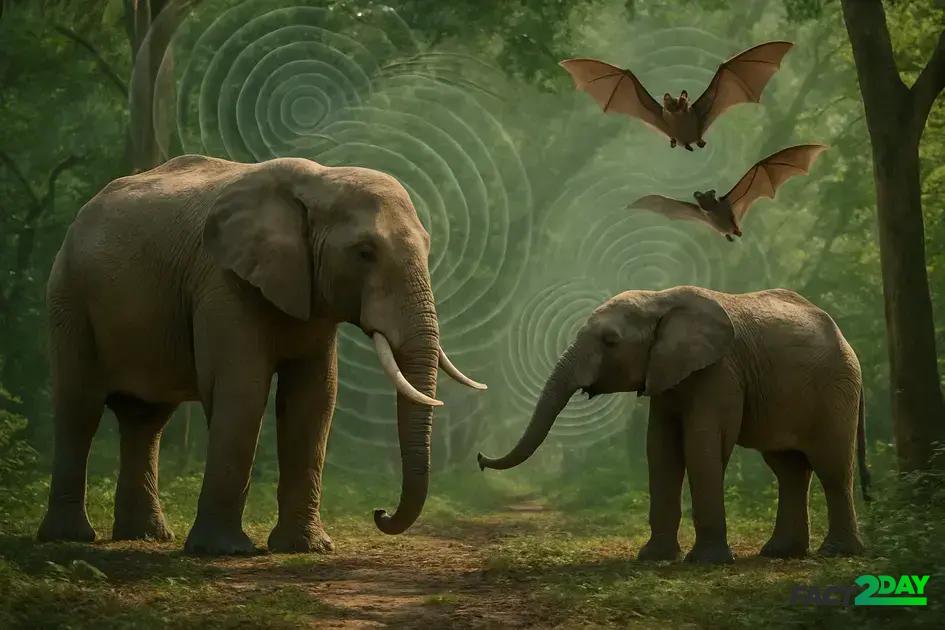
Ultrasonic/infrasonic animal communication involves animals using sound frequencies beyond human hearing to communicate over long distances, enabling survival and social interaction through ultrasonic and infrasonic waves.
You may never have noticed, but ultrasonic/infrasonic animal communication immerses us in a secret world of sounds that escape our normal hearing. Have you ever wondered how animals communicate using frequencies we can’t hear? Let’s explore this fascinating connection together.
Ultrasonic frequencies and their role in animal communication
Ultrasonic frequencies are sounds that have a higher pitch than humans can hear, typically above 20,000 Hz. Many animals use these frequencies to communicate, navigate, or detect prey. For example, bats rely on ultrasonic echolocation to hunt insects in complete darkness by emitting high-pitched sounds and interpreting the echoes that bounce back.
Dolphins also use ultrasonic clicks for communication and locating objects underwater. These sounds travel long distances underwater with minimal loss, allowing complex social interactions even in murky environments. Ultrasonic communication can carry detailed information that helps animals coordinate group behaviors or warn of danger.
The ability to produce and perceive ultrasonic waves offers advantages such as avoiding detection by predators or prey that cannot hear these frequencies. This specialized communication method shows how evolution adapts sensory systems for survival in diverse habitats.
Studying ultrasonic frequencies in animals not only unravels their hidden communication but also inspires technological advances in sonar, medical imaging, and robotics. Understanding these sounds deepens our appreciation of the natural world’s complexity and the ingenuity of animal communication systems.
The role of infrasonic frequencies in natural environments
Infrasonic frequencies are sound waves below 20 Hz, which are inaudible to humans but play a crucial role in animal communication. Large animals such as elephants and whales use infrasonic sounds to communicate over long distances, sometimes spanning hundreds of miles.
Elephants produce infrasonic rumbles that can travel through the ground and air, allowing them to convey messages about mating, danger, or social bonding across vast savannas. Similarly, whales emit deep infrasonic calls underwater to coordinate movements and find mates across the ocean.
This form of communication acts as a natural long-distance signaling system that is less affected by obstacles like dense foliage or rough terrain. Infrasonic waves can travel farther with less energy loss than higher-pitched sounds, making them ideal for animals living in large or obstructed environments.
Researchers use specialized equipment to detect and study these sounds to better understand animal behavior and ecology. Recognizing the role of infrasonic frequencies highlights the complex ways animals have adapted their communication to their habitats and survival needs.
How to study and perceive the invisible sounds of nature
Studying and perceiving invisible sounds in nature requires specialized equipment and techniques. Devices like ultrasonic detectors and infrasound sensors convert frequencies beyond human hearing into audible ranges or visual data. This technology allows scientists and enthusiasts to observe animal communication that would otherwise go unnoticed.
Field researchers often use microphones sensitive to a wide frequency range to capture sounds from bats, whales, elephants, and other animals. These recordings are analyzed with software that displays sound patterns, helping to decode messages and behaviors. Techniques such as spectrogram analysis reveal details about the frequency, duration, and intensity of calls.
Some animals emit signals in complex sequences or overlapping frequencies, making it crucial to use advanced signal processing methods. Additionally, environmental factors such as wind, terrain, and background noise can impact the perception of these sounds, so choosing the right location and timing is essential.
For those interested in experiencing these sounds firsthand, there are apps and devices designed for education and citizen science. By amplifying or translating ultrasonic and infrasonic waves, these tools open a new window into the hidden soundscape of nature, fostering greater awareness and understanding of animal communication.
Understanding the hidden world of animal communication
Exploring how animals use ultrasonic and infrasonic sounds opens up a fascinating realm beyond human hearing. These invisible waves help animals communicate over distances and in environments where normal sounds can’t travel well.
With modern technology, we can now detect and study these signals, revealing the complex ways animals interact and survive. Learning about these sounds not only improves our knowledge of nature but also inspires new ideas in science and technology.
By paying attention to the sounds we usually can’t hear, we gain a deeper connection to the natural world and the amazing creatures around us.