How Animals Navigate Thousands of Miles
Animal migration navigation reveals the incredible ways creatures find their paths across vast distances. Discover their astonishing secrets.
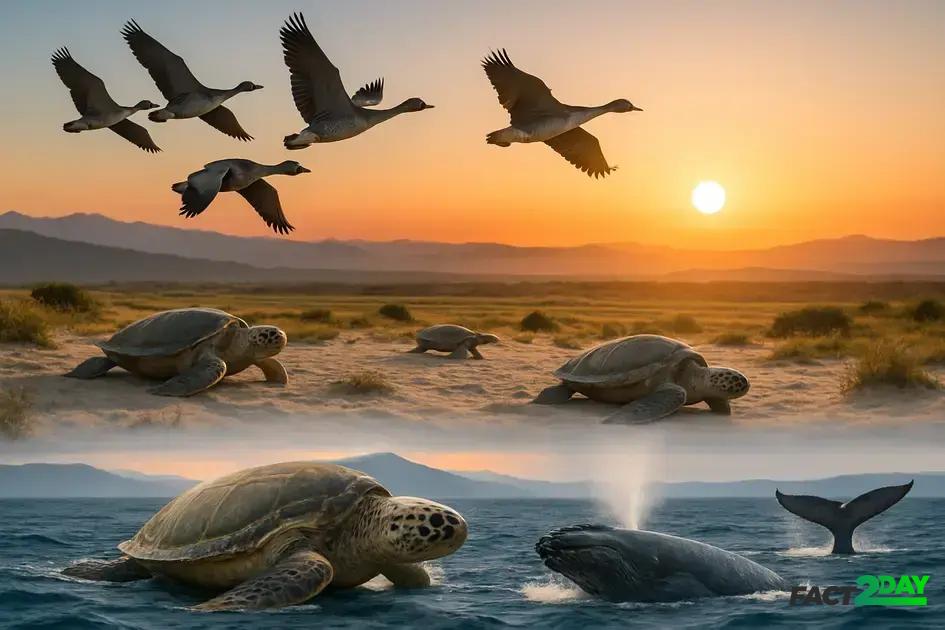
Animal migration navigation involves instinct, sensory cues like the Earth’s magnetic field, visual landmarks, and learned experience, enabling species to travel thousands of miles accurately across changing environments.
Animal migration navigation is a fascinating puzzle. Ever wondered how birds or sea turtles find their way thousands of miles without getting lost? Let’s explore the incredible journeys behind these natural navigators and what science has uncovered so far.
The basics of animal migration
Animal migration is a regular, often seasonal movement from one region to another, driven by changes in weather, food availability, or breeding needs. Many animals travel long distances, navigating across continents and oceans. Migration is a natural instinct that allows species to survive and reproduce efficiently.
These journeys vary widely among species. For example, monarch butterflies travel thousands of miles to reach specific overwintering sites, while some whales swim across entire oceans to reach warmer breeding grounds. The ability to migrate helps animals avoid harsh climates and find food during scarce periods.
In most cases, migration follows well-established routes known as flyways or pathways. These routes are used year after year and often passed down through generations. Animals depend on cues like daylight changes and temperature to know when to begin their journey.
Why migration matters
Migration supports the balance of ecosystems by enabling species to access diverse habitats. It also maintains genetic diversity, as animals mate in different locations along their route. Many ecosystems rely on migratory species for pollination, seed dispersal, or as part of the food chain.
Understanding the basics of animal migration helps us appreciate the complexity and interconnectedness of life on Earth. It also highlights why protecting migratory routes and habitats is critical for conservation efforts.
How animals sense direction naturally
Animals use a variety of natural mechanisms to sense direction and navigate during migration. One key method is the use of the Earth’s magnetic field, which acts like a built-in compass for many species, including birds, sea turtles, and salmon. This magnetic sense allows them to detect direction and maintain their route even when visual landmarks are unavailable.
Besides magnetic cues, animals also rely on the position of the sun and stars to orient themselves. Birds often use the sun’s position during the day and star patterns at night to keep track of their path. Some species adjust their internal clocks to interpret these celestial cues accurately.
Other natural senses involved
Scent plays an important role, especially for animals like salmon and pigeons. They use smell to recognize specific locations and find their way back to breeding grounds or nests. Sound waves and ocean currents can also provide directional information for marine animals.
Visual landmarks such as mountains, rivers, and coastlines help animals maintain their course during migration. Many species memorize these landmarks from previous journeys and use them to avoid getting lost.
Overall, the natural ability to sense direction combines multiple senses working together. This complex system helps animals navigate thousands of miles with remarkable precision.
The role of the Earth’s magnetic field in navigation
The Earth’s magnetic field serves as a powerful and reliable navigational aid for many migrating animals. This invisible force surrounds the planet, providing a global map that animals can detect using specialized cells containing magnetic particles. These cells act like a compass, helping animals sense direction even when landmarks or the sun are not visible.
Birds, sea turtles, and some fish are known to use the Earth’s magnetic field to find their way during long journeys. Scientists believe animals can detect both the intensity and the angle of the magnetic field, enabling them to pinpoint their position and adjust their course.
How animals detect magnetic fields
Research shows that certain cells in the eyes or brains of animals contain magnetoreceptors—structures sensitive to magnetic forces. For instance, birds might use proteins in their eyes that respond to magnetic fields, allowing them to “see” magnetic directions as visual patterns or light effects.
Magnetic navigation allows animals to travel thousands of miles across oceans and continents with remarkable accuracy. This ability is key for survival, feeding, and reproduction, especially when other cues like the sun or stars are obscured by clouds or at night.
Understanding the role of the Earth’s magnetic field in animal navigation helps explain the precision of migration and guides conservation efforts that protect crucial migratory routes.
Visual cues animals use on migration routes
Animals use a variety of visual cues to navigate their migration routes. These cues include landmarks like mountains, rivers, coastlines, and forests, which help them stay on course during their long journeys. Animals often memorize these features from past migrations to make their navigation more efficient.
For example, birds rely heavily on familiar landscapes and geographical features. They can spot distinctive shapes and colors from the sky, using these details to guide their flight paths. Similarly, sea turtles use the outline of coastlines and the ocean floor to find nesting sites.
How visual cues improve navigation accuracy
Visual landmarks provide constant reference points that keep migrating animals oriented. This is especially important when other navigation aids, like magnetic fields or celestial cues, are not accessible. Animals combine multiple cues to reduce errors and avoid getting lost, ensuring they reach their destinations successfully.
Animals also respond to changes in light and shadow, which can indicate time of day or weather conditions. These subtle changes help them adjust their direction during migration, showing how adaptable and precise their navigation skills are.
Overall, visual cues are a critical part of the complex navigation system animals use during migration. They work hand-in-hand with other senses to support long-distance travel.
How weather impacts animal migration navigation
Weather plays a crucial role in animal migration navigation, influencing when and how animals travel. Changes in temperature, wind patterns, and precipitation can affect migration timing and routes. Many animals wait for favorable weather conditions to begin their journey to conserve energy and increase survival chances.
Wind direction and speed can either help or hinder migration. Tailwinds assist birds and insects by pushing them forward, making travel easier and faster. Conversely, strong headwinds or storms can force animals to delay migration or alter their path to avoid dangerous conditions.
Effects of temperature and precipitation
Temperature shifts signal seasonal changes that trigger migration behaviors. For example, colder temperatures in the north prompt birds to head south for warmer climates. Heavy rain or drought can influence food availability, causing animals to adjust their routes or timing.
Storms and extreme weather events pose risks during migration, sometimes leading to disorientation or exhaustion. Animals have developed strategies like seeking shelter or flying at different altitudes to cope with unpredictable weather challenges.
Understanding weather’s impact helps scientists predict migration patterns and supports conservation efforts, especially as climate change alters traditional weather systems. Protecting migratory species requires considering how shifting weather affects their incredible journeys.
The importance of memory and learning in navigation
Memory and learning play vital roles in animal migration navigation. Many animals rely on their past experiences to remember migration routes, landmarks, and feeding sites. This ability helps them navigate more efficiently on subsequent journeys.
For example, young birds often learn migration routes by following adults. Over time, they memorize key details like resting spots and safe pathways. This learned knowledge allows them to avoid dangers and find resources needed for survival.
How memory improves navigation
Animals use spatial memory to recall the locations of important features such as rivers, mountains, or feeding grounds. This helps them stick to known routes, reducing the risk of getting lost. Some species also adapt their routes based on changes in the environment, showcasing their learning ability.
Memory isn’t limited to visual cues; it can include smells and sounds that animals associate with certain places. This multi-sensory memory enhances their navigation skills and helps them adjust to new challenges.
Learning during migration is an ongoing process. Animals can improve their navigation skills by remembering previous successes and failures, allowing them to become skilled travelers over time.
Technologies scientists use to study animal navigation
Scientists use a range of advanced technologies to study how animals navigate during migration. These tools help researchers track movement patterns, understand navigation mechanisms, and gather data in real time.
GPS tracking devices are commonly attached to animals like birds, whales, and turtles. These devices provide precise location data, revealing migration routes and stopover points. This technology has transformed our understanding of migratory paths by providing detailed, long-distance movement records.
Other important tools
Satellite telemetry expands the range of study to include animals traveling in remote or ocean areas. It allows scientists to monitor movements globally and track seasonal changes. Radio telemetry, though more limited in range, is useful for tracking animals within localized migration zones.
Researchers also use miniature sensors to record environmental factors such as temperature, humidity, and magnetic fields. These sensors help scientists correlate navigation behavior with external conditions.
In addition, advanced imaging techniques like stable isotope analysis and genetic mapping provide insights into population origins and migration connectivity, helping reveal complex migration networks.
Combining these technologies offers a comprehensive picture of animal navigation, informing conservation strategies and deepening our knowledge of the natural world.
The challenges animals face in modern environments
Modern environments present numerous challenges for migrating animals. Urbanization, habitat loss, and pollution disrupt traditional migration routes and reduce the availability of vital resting and feeding spots. These changes can cause animals to become disoriented or exhausted during their journeys.
Light pollution from cities confuses nocturnal migrators like birds and sea turtles, making it harder for them to navigate using natural cues such as stars or moonlight. This can lead to dangerous detours or collisions with man-made structures.
Impact of climate change and human barriers
Climate change alters weather patterns, shifting the timing of migration and availability of food sources. Some species struggle to adapt quickly, which affects their survival and reproductive success. Human-made barriers like roads, dams, and fences also obstruct migration paths, forcing animals to find new, often longer or riskier routes.
Pollution, including plastic waste and chemical contaminants, harms wildlife health and contaminates waters and habitats critical for migration. Noise pollution from transportation and industrial activity further disturbs animals during travel.
Conservation efforts today must address these challenges by protecting habitats, creating safe corridors, and reducing pollution. Understanding modern threats helps ensure that migratory species can continue their remarkable journeys across changing landscapes.
The role of instinct versus experience in navigation
Instinct and experience both play important roles in how animals navigate during migration. Instinct drives many animals to start their migrations without prior learning. This natural behavior is hardwired, ensuring that even young or inexperienced animals can begin their journey in the right direction.
However, experience enhances navigation accuracy. Animals that survive multiple migrations learn from past trips, memorizing landmarks, favorable conditions, and potential dangers. This knowledge helps them make better decisions on future journeys.
Balancing instinct and learning
For example, many bird species rely on instinct to trigger migration and navigate early routes, but older birds use experience to refine those routes and lead younger members. Sea turtles use a mix of instinct to begin nesting migrations and learned cues to find the best beaches.
This combination allows animals to be flexible and adapt to changing environments. Instinct provides a strong foundation, while experience helps fine-tune navigation for success over time.
Understanding the balance between these two factors reveals the complexity behind the incredible migratory feats performed by animals each year.
Conservation efforts informed by navigation studies
Navigation studies provide essential information that supports conservation efforts for migratory species. By understanding the routes, behaviors, and challenges animals face during migration, conservationists can protect critical habitats and migration corridors. This knowledge helps focus resources on areas most vital to species survival.
Identifying important stopover sites allows for the protection of feeding and resting areas. These sites are crucial for animals to regain energy on long journeys. Conservation efforts can then prioritize safeguarding these locations from development or pollution.
Mitigating human impacts
Studies reveal how human-made structures, such as buildings, power lines, and wind turbines, affect migration. This enables the design of wildlife-friendly infrastructure and strategies to reduce collisions and disturbances during migration seasons.
Understanding navigation also aids in creating wildlife corridors that connect fragmented habitats. These corridors allow safer movement across regions affected by urbanization and agriculture.
Community engagement and policy changes often follow from navigation research, raising awareness about the importance of protecting migratory species and their environments. Effective conservation combines science, education, and policy to ensure these remarkable journeys continue for generations to come.
Wrapping up animal migration navigation
Animal migration navigation is an amazing natural process that combines instinct, learning, and environmental cues to guide animals on incredible journeys. Understanding these mechanisms helps us appreciate the complexity and resilience of wildlife.
From the Earth’s magnetic field to visual landmarks, animals use multiple tools to find their way across vast distances. Science and technology continue to uncover these secrets, supporting conservation efforts to protect migratory species.
By valuing and protecting migration routes and habitats, we ensure these remarkable travels can continue for future generations. Exploring animal navigation invites us to connect more deeply with the natural world around us.