O Laboratório Gamificado: Como Videogames Estão Ajudando a Ciência e a Pesquisa Médica
Jogos para pesquisa científica estão abrindo novas portas para descobertas médicas, unindo diversão e ciência em experiências inovadoras.
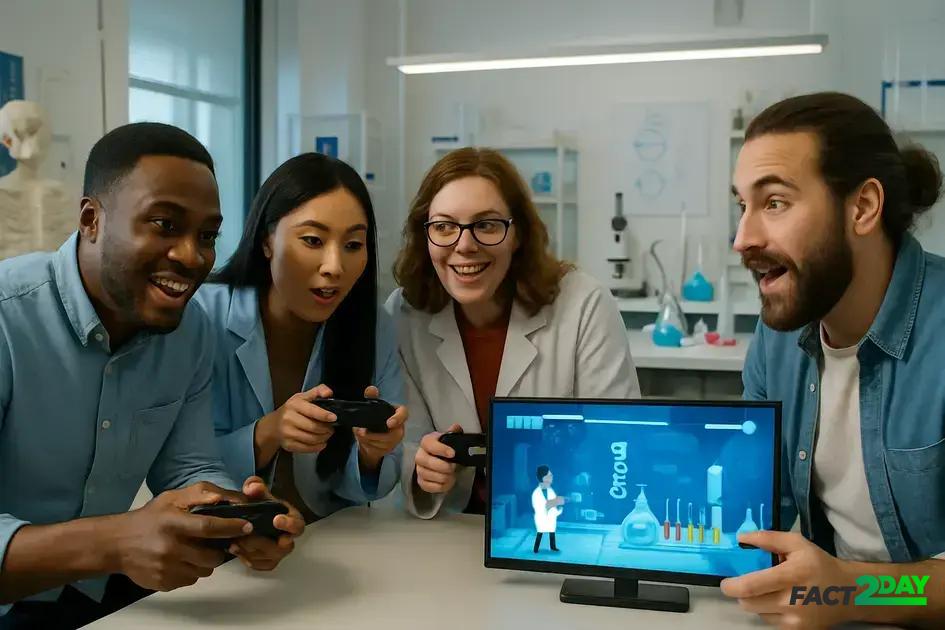
Jogos para pesquisa científica transformam dados complexos em descobertas médicas ao envolver jogadores na resolução de desafios que aceleram inovação, combinando inteligência humana e tecnologia para avançar tratamentos e conhecimento.
Você já parou para pensar em como os jogos para pesquisa científica podem ser aliados surpreendentes na busca por respostas na medicina? Talvez nunca tenha visto videogames além do entretenimento, mas eles carregam um potencial incrível para aproximar ciência e pessoas de forma inovadora.
como jogos transformam dados complexos em descobertas valiosas
Games designed for scientific research play a crucial role in turning complex data into valuable discoveries. These games transform intricate datasets into interactive challenges that players can solve intuitively. By engaging players in pattern recognition and problem-solving, researchers gather insights that traditional analysis methods might miss.
Transforming Complexity through Gameplay
Scientific data, often overwhelming and dense, becomes accessible when embedded within game mechanics. Players manipulate elements, test hypotheses, and explore scenarios in ways that reveal hidden trends and anomalies. This human intuition combined with game dynamics accelerates the discovery process.
The Power of Crowdsourcing in Research
Millions of players worldwide can participate simultaneously, making it possible to analyze data on a scale unattainable by individual labs. This collective effort enhances accuracy and speeds up tasks such as protein folding, genome sequencing, and behavioral studies.
By engaging diverse participants, games create multiple perspectives on the data. Players’ unique approaches often lead to unexpected revelations, fostering innovation beyond algorithmic computation.
a interação do jogador como ferramenta de pesquisa médica
Player interaction in scientific games is a powerful tool for medical research. When players engage with carefully designed challenges, their actions produce data that researchers analyze to understand diseases and develop treatments.
How Player Decisions Inform Research
Every move a player makes can mimic real-world biological processes or simulate medical problems. By tracking these interactions, scientists uncover patterns and test hypotheses about human health.
Human Insight Beyond Algorithms
Players often spot details that automated systems miss. Their problem-solving and creative thinking add depth to research, making the gaming environment an unexpected but effective lab for discovering new medical knowledge.
This collaboration between humans and science builds a dynamic research process where feedback loops from player behavior guide real medical innovations, such as drug development or disease modeling.
exemplos reais de jogos impulsionando projetos científicos
Several real-world games have successfully driven scientific projects by turning complex challenges into engaging tasks for players. For example, Foldit is a game where players fold protein structures, helping scientists understand diseases and design new drugs.
Foldit’s Impact on Medical Research
Players’ solutions have led to breakthroughs in protein folding problems that were difficult for computers alone. This has sped up research on diseases like cancer and Alzheimer’s.
Other Notable Scientific Games
EyeWire tasks players with mapping neurons in the brain, contributing to neuroscience research. Meanwhile, Sea Hero Quest collects data on navigation skills to study dementia, involving millions worldwide.
These examples show how game-based research leverages human creativity and problem-solving to accelerate scientific discovery in ways traditional methods cannot.
Bringing games and science together
Real scientific games show how playing can lead to important discoveries. By engaging people worldwide, games like Foldit and EyeWire have accelerated research in medicine and neuroscience.
These projects prove that human creativity combined with technology can solve problems faster and better. This approach is changing how scientists explore complex data and develop new treatments.
As games continue to evolve, they offer exciting opportunities for both players and researchers to make a real impact on science and health.