The Quantum Leap: Where Physics Meets Life in the Mysterious Realm of Quantum Biology
Quantum Entanglement in Biology reveals how nature’s tiniest connections influence life’s deepest mysteries. Explore this fascinating interplay of physics and biology.
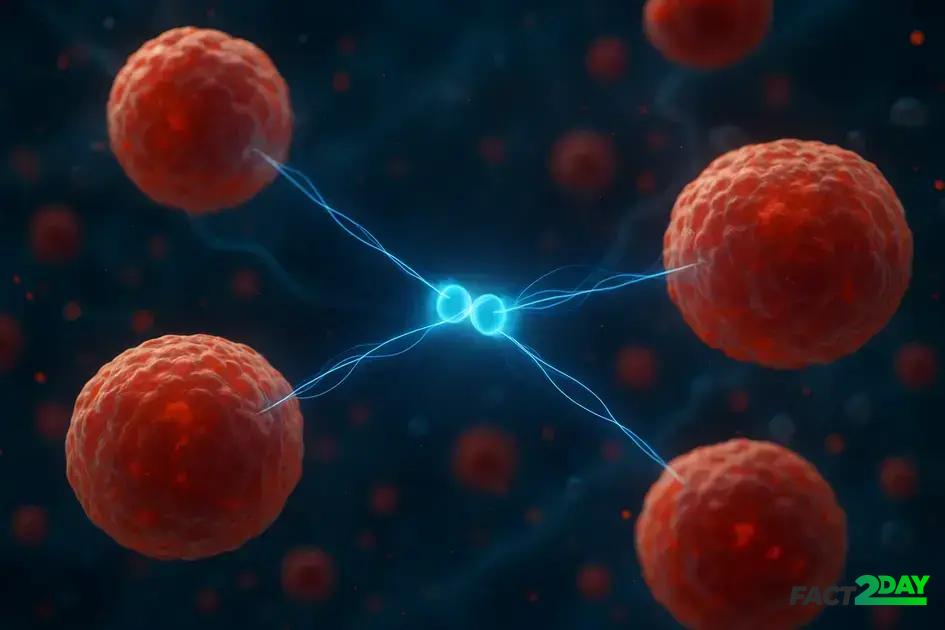
Quantum Entanglement in Biology refers to the phenomenon where particles within living systems are interlinked at the quantum level, influencing processes like photosynthesis, navigation, and possibly cognition, unlocking new understanding in medicine, technology, and consciousness studies.
Quantum Entanglement in Biology invites us to peer into a realm where physics and life intertwine in surprising ways. Have you ever wondered how mysterious quantum links might shape living systems around us? This journey uncovers fascinating insights waiting beneath everyday existence.
understanding quantum entanglement and its biological significance
Quantum entanglement is a phenomenon where particles become linked, sharing states instantly regardless of distance. In biology, this suggests that molecules inside living cells might communicate in ways classical physics can’t explain. Scientists are exploring if entangled particles influence processes like enzyme reactions or cellular signaling.
This connection could mean that biological systems leverage quantum effects for efficiency and precision. For example, entanglement might help explain how birds navigate using Earth’s magnetic field or how plants transfer energy during photosynthesis.
Understanding entanglement’s role requires blending physics and biology, opening new frontiers in science. It pushes us to rethink communication and interaction at a microscopic level, where biology and quantum mechanics intersect.
how quantum effects appear in living organisms
Quantum effects in living organisms appear through processes that involve particles acting in ways different from classical physics. These effects include quantum coherence, where particles stay connected over time, and quantum tunneling, which allows particles to pass through barriers they normally couldn’t.
For example, in enzymes, quantum tunneling helps speed up reactions by allowing particles to shortcut energy barriers. This effect increases the efficiency of vital biochemical processes. Additionally, quantum coherence plays a role in the way some animals sense magnetic fields for navigation, like migratory birds.
Recent studies also suggest that quantum vibrations might influence smells and photosynthesis, letting plants convert sunlight to energy with remarkable precision. These discoveries hint that living systems might harness quantum physics to enhance their survival and function.
the role of entanglement in photosynthesis and energy transfer
During photosynthesis, plants capture sunlight and convert it into energy through complex molecular systems. Recent research shows that quantum entanglement plays a key role in this energy transfer, allowing particles to coordinate in ways that boost efficiency.
Entangled particles help excitons—energy packets created by light absorption—explore multiple pathways simultaneously to find the fastest route to reaction centers. This quantum shortcut minimizes energy loss and maximizes the plant’s ability to produce food.
Studies using ultrafast spectroscopy have revealed signs of long-lasting quantum coherence in photosynthetic complexes, suggesting that plants may exploit quantum mechanics naturally. This challenges older views of biology as purely classical and invites new thinking about how life harnesses physics.
Energy transfer aided by entanglement is not limited to plants but might also appear in other biological structures where swift, efficient communication is vital.
quantum biology’s impact on neuroscience and cognition
Quantum biology is shedding new light on how the brain works, suggesting quantum processes might influence neuroscience and cognition. Some researchers propose that quantum entanglement could play a role in neuron communication and information processing, potentially impacting memory and consciousness.
For example, the theory of quantum coherence in microtubules—tiny structures inside neurons—suggests these particles might maintain quantum states long enough to affect brain functions. This challenges traditional views that brain activity is purely classical.
Such quantum effects might help explain how the brain performs complex tasks like decision-making, pattern recognition, and rapid information transfer. While still controversial, this field opens exciting possibilities for understanding consciousness and mental health.
Ongoing experiments strive to detect quantum signals in brain activity and clarify how these mechanisms could influence cognition, possibly leading to new treatments for neurological disorders.
implications for medicine and future technologies
The study of quantum entanglement in biology is opening new paths for medicine and technology. Quantum principles might improve how we diagnose and treat diseases, by unlocking more precise drug interactions and enhancing medical imaging with quantum sensors.
Quantum computing could model complex biological systems faster than ever, leading to breakthroughs in personalized medicine and genetic research. This means doctors might soon tailor treatments using insights from quantum biology, improving outcomes for patients.
Emerging technologies may use entangled particles for secure communication and ultra-sensitive detection of biological markers. This can revolutionize how we monitor health and detect illnesses early.
Quantum biology’s influence on future devices promises smarter, faster, and more efficient tools that bridge physics and life sciences, paving the way for innovations we are just beginning to imagine.
exploring ethical and philosophical questions around quantum biology
Quantum biology raises deep ethical and philosophical questions about the nature of life and consciousness. If quantum phenomena influence living beings, it challenges our current understanding of biology grounded in classical science.
One key question is how quantum effects might relate to free will and decision-making. If particles can be entangled across systems, does that imply connections beyond what we observe at the macroscopic level?
There are also concerns about the implications of manipulating quantum biological processes. As technology advances, controlling quantum states in living organisms might raise questions about safety, natural boundaries, and moral responsibilities.
Philosophical debates explore whether quantum biology might blur the distinction between mind and matter, offering new perspectives on consciousness and existence. These discussions invite scientists and ethicists to work together in navigating this emerging field.
The promise and challenges of quantum biology
Quantum entanglement in biology opens an exciting new chapter in understanding life. It merges physics with biology, showing us complex connections at the smallest scales.
This science could transform medicine, technology, and how we view consciousness, but it also raises important ethical and philosophical questions.
As research progresses, we will uncover more about how these quantum phenomena shape living systems, offering possibilities we are only beginning to imagine.