Beyond Gold: The Curious Evolution of Money from Seashells to Digital Currency
Explore the Evolution of Money from ancient seashells to modern digital currencies and discover how our concept of value has transformed.
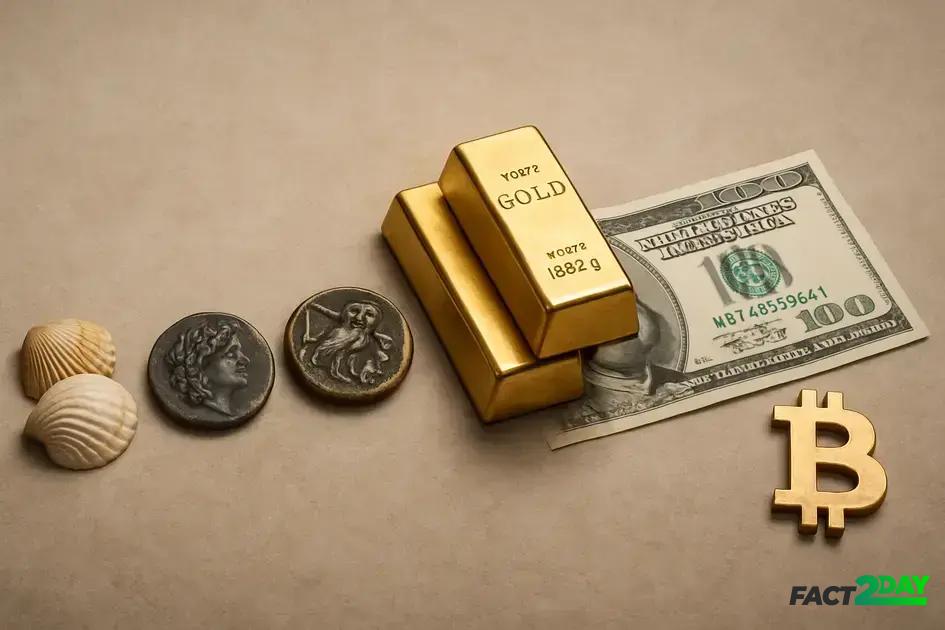
The Evolution of Money traces the transformation from barter and seashells to metal coins, precious metals, paper money, and now digital currencies and cryptocurrencies, reflecting changing technologies and economic needs across history.
Have you ever thought about how money evolved? The Evolution of Money is a fascinating journey, from humble seashells used centuries ago to the digital currencies shaping today’s economy. Let’s explore this curious transformation together.
The origins of money: from barter to seashells
Before money existed, people relied on barter to trade goods and services directly. This system had many limitations, as it required a double coincidence of wants; both parties needed something the other possessed. This challenge led early societies to seek more efficient mediums of exchange.
In many coastal communities, seashells emerged as one of the earliest forms of money. Their rarity, durability, and portability made them practical for trade. These shells were often valued for their beauty and uniqueness, giving them intrinsic worth beyond mere utility.
Seashell money was more than just a trade tool; it reflected social status and cultural significance. Different shells were used in various regions, such as cowrie shells in Africa and Asia. This early form of money helped simplify exchanges and laid the groundwork for the complex monetary systems that followed.
The rise of metal coins and early currencies
As trade expanded, societies needed more durable and standardized forms of money. This led to the rise of metal coins, which became one of the first widely accepted currencies. Metals like gold, silver, and copper were chosen for their rarity and easy divisibility.
Early coins featured marks or images from rulers or city-states to guarantee their authenticity and value. The use of metal coins simplified transactions, made trade more efficient, and helped governments control economic systems by regulating currency production.
The role of early currencies in trade
These currencies facilitated commerce both locally and across distant regions. With coins, merchants could carry wealth in a compact form instead of bulky goods. This development played a vital role in growing economies and building complex trade networks.
Gold and silver: the timeless monetary standard
Gold and silver became the most trusted forms of money because of their rarity, beauty, and durability. Societies used these precious metals to create coins that held value across regions and cultures. The intrinsic value of gold and silver made them ideal for savings and trade.
Governments and empires often minted gold and silver coins with intricate designs and official seals, guaranteeing their authenticity. These metals symbolized wealth and power, and their use as money lasted for thousands of years.
Why gold and silver endured
Unlike materials that could easily degrade or be counterfeit, gold and silver maintained their worth over time. Their universal appeal meant they were accepted everywhere, facilitating long-distance trade and economic stability.
Paper money and the birth of banks
The introduction of paper money marked a major shift in how people exchanged value. Early paper currency was easier to carry and transfer compared to heavy metal coins. Governments and banks began issuing notes representing a promise to pay the bearer a certain amount of precious metal.
This innovation led to the birth of banks, institutions that managed currency, accepted deposits, and provided loans. Banks helped build trust in paper money by guaranteeing its redeemability and facilitating economic growth.
The role of banks in stabilizing currency
Banks acted as intermediaries, issuing more notes than they held in metals, which expanded the money supply but also required careful regulation. Their evolving role supported trade, investment, and the development of modern economies.
The digital revolution: cryptocurrencies and e-wallets
The digital revolution has transformed money once again with the advent of cryptocurrencies and e-wallets. Cryptocurrencies like Bitcoin use blockchain technology to enable secure and decentralized transactions without intermediaries.
E-wallets allow users to store their digital currencies and make instant payments using smartphones. This shift makes transactions faster, more convenient, and accessible worldwide.
How cryptocurrencies challenge traditional money
Unlike government-issued currencies, cryptocurrencies operate on a decentralized network, reducing reliance on banks. This raises questions about trust, regulation, and the future of money in a digital age.
What the future holds for the evolution of money
The future of money promises exciting changes as technology advances. Concepts like digital currencies, blockchain, and decentralized finance (DeFi) are reshaping how we think about money and transactions.
We may see greater use of central bank digital currencies (CBDCs), which are digital forms of government-backed money designed to make payments faster and more secure. At the same time, innovations in artificial intelligence and biometric security will enhance how we protect and use money.
Potential challenges and opportunities
While these advancements offer convenience and accessibility, they also raise questions about privacy, regulation, and financial inclusion. Navigating these challenges will be crucial in shaping a fair and efficient monetary system for the future.
The ongoing journey of money
The evolution of money shows how human societies have always sought better ways to exchange value. From seashells to digital currencies, each step reflects innovation and the changing needs of people.
Understanding this journey helps us appreciate the convenience and trust we place in modern money. As technology continues to advance, staying informed about new developments will keep us prepared for the future of finance.
Embracing change while addressing challenges can lead to a monetary system that is more accessible, secure, and efficient for everyone.