Tardigrades Use Ancient Crystals to Survive Radiation
Explore how tardigrade time crystals help these resilient creatures endure extreme radiation, revealing ancient survival secrets.
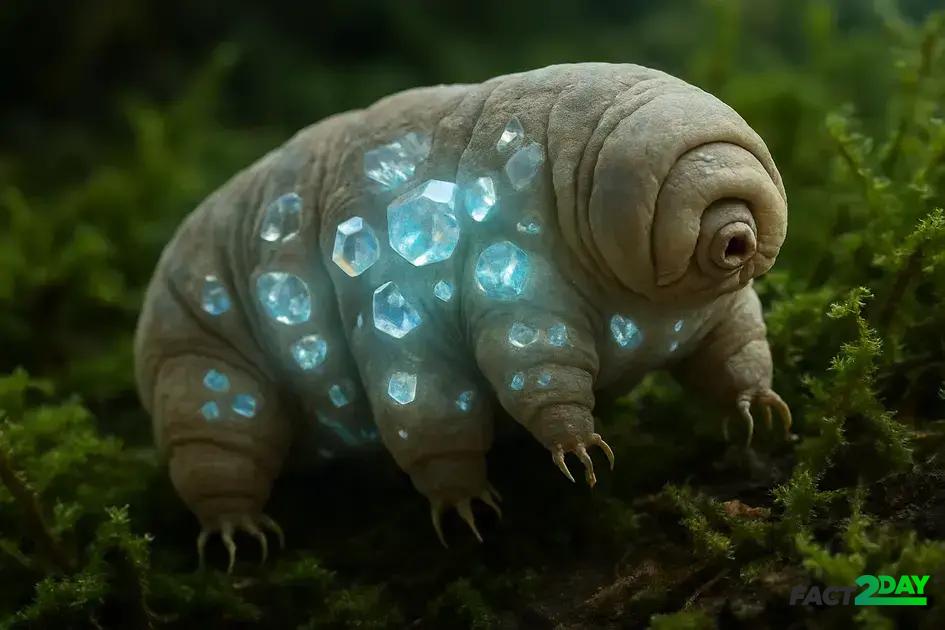
Tardigrade time crystals are quantum structures that enable tardigrades to survive extreme radiation by stabilizing their cellular functions and enhancing DNA repair, offering potential applications in medicine, space travel, and quantum technology.
Tardigrade time crystals might sound like science fiction, but they offer fascinating clues about how these tiny creatures survive intense radiation. Ever wondered what ancient secrets they hold? Let’s unravel this extraordinary natural phenomenon together.
the mysterious resilience of tardigrades
Tardigrades, often called water bears, are microscopic animals renowned for their extraordinary resilience in extreme environments that would be lethal to most life forms. These tiny creatures can survive temperatures from nearly absolute zero to over 300°F, pressures higher than those in the deepest ocean trenches, and even intense radiation.
This remarkable toughness is tied to their ability to enter a state called cryptobiosis, where their metabolic activities nearly stop, allowing them to endure harsh conditions for years. When conditions improve, tardigrades rehydrate and resume normal functions, showing an incredible survival strategy.
Scientists continue to study tardigrades to understand the biological mechanisms behind their resilience. Their unique defenses include specialized proteins and DNA repair systems, which help them resist damage caused by radiation and desiccation. These insights could inspire advances in medicine, space travel, and materials science.
understanding time crystals and their nature
Time crystals are a recently discovered phase of matter that defy traditional physical laws by exhibiting movements that repeat in time without expending energy. Unlike ordinary crystals, which have a repeating arrangement in space, time crystals display a pattern that repeats in time, making them a fascinating subject in physics.
These crystals maintain a constant oscillation at their lowest energy state, known as a ground state. This perpetual motion challenges the classical understanding of thermodynamics and opens new doors in research. Scientists first theorized time crystals in 2012, and experimental evidence followed years later.
Time crystals are not typical crystals you can hold; they exist at the quantum level and involve complex interactions of particles. Their unique properties could revolutionize fields such as quantum computing, offering more stable systems for storing and processing information.
Physical Characteristics of Time Crystals
Physically, time crystals involve atoms or ions arranged in a way that their states cycle periodically. This cycling happens even without energy input, making them a break from normal matter behavior. These quirks make them ideal for studying the fundamentals of quantum mechanics.
Potential Applications
Researchers believe time crystals could improve quantum computers by maintaining coherence longer than current methods allow. This stability is key for practical quantum devices. Their unusual temporal patterns may also help in understanding nonequilibrium systems in physics.
how tardigrades use time crystals to survive radiation
Tardigrades have an incredible way of surviving intense radiation through the use of time crystals. These ancient, quantum structures help protect their cells from damage by stabilizing molecular processes during exposure to harmful rays. Unlike typical biological methods, time crystals operate at a quantum level, offering a new layer of defense.
When exposed to radiation, tardigrades activate these time crystals to maintain order in their cellular functions. This prevents the usual disruptions that radiation causes to DNA and proteins, allowing the creature to repair damage more efficiently once the threat passes.
Quantum-level protection
Time crystals create a repeating, stable pattern in time that resists the chaos radiation typically induces. This quantum stability means that the tardigrade’s biological processes continue uninterrupted despite harmful external forces.
Enhanced DNA repair
The protection from time crystals also supports robust DNA repair mechanisms. This means that even if some damage occurs, tardigrades can quickly fix broken strands and maintain genetic integrity, crucial for survival in extreme conditions.
Scientists are fascinated by this system as it suggests new ways to protect human cells from radiation, potentially improving cancer treatments and space travel safety.
scientific studies revealing this adaptation
Scientists have conducted multiple studies to understand how tardigrades survive extreme radiation, focusing on their use of time crystals. Laboratory experiments expose tardigrades to high doses of radiation, observing their unique cellular responses that prevent DNA damage and preserve vital functions.
Key findings from research
Recent research reveals that the presence of time crystals helps tardigrades maintain stability in their molecular structures. These crystals act like tiny quantum clocks, regulating biological processes that usually break down under radiation stress.
Advanced imaging and spectroscopy techniques have shown that time crystals may protect proteins and enzymes critical for DNA repair. This preservation ensures that tardigrades can quickly recover once the radiation threat is removed.
Experimental methods
Studies use electron microscopes and quantum sensors to detect these crystals within tardigrade cells. Controlled experiments simulate space and nuclear radiation, testing these animals’ survival rates and biological changes.
These scientific efforts deepen our understanding of quantum biology and prompt the exploration of new materials and technologies inspired by tardigrades’ extraordinary survival skills.
implications for human technology and medicine
The discovery of time crystals in tardigrades opens exciting possibilities for human technology and medicine. These quantum structures could lead to new ways of protecting human cells from radiation damage during cancer treatments or long-term space missions.
Advances in medical treatments
By mimicking how tardigrades use time crystals to stabilize cellular functions, researchers aim to develop therapies that reduce side effects from radiation therapy. This could improve recovery times and protect healthy tissues during aggressive treatments.
Impact on space travel
Space missions expose astronauts to harmful cosmic radiation. Time crystals might inspire protective materials or biological modifications to increase human resilience in space, enabling longer and safer journeys.
Quantum computing and data storage
Beyond biology, time crystals have potential applications in quantum computing. Their stable oscillations could improve qubit coherence, leading to faster and more reliable quantum computers. This technological leap would impact many industries, including medicine.
These implications showcase how understanding tardigrades’ natural defenses can cross disciplines, leading to breakthroughs that enhance human health and technology.
exploring future research directions
Future research on tardigrades and their use of time crystals is poised to unlock new scientific frontiers. Scientists aim to explore how these quantum structures can be harnessed for practical uses in technology and medicine.
Expanding quantum biology studies
Researchers are diving deeper into quantum biology to understand how time crystals form and function naturally within living organisms like tardigrades. This could reveal unknown biological mechanisms that enhance survival.
Developing advanced materials
One goal is to create new materials inspired by time crystals that can provide robust protection against radiation and environmental stress. These materials may benefit industries such as aerospace, healthcare, and electronics.
Applications in human health
Future studies will also focus on translating tardigrades’ protective strategies into therapies that shield human cells from damage during treatments like chemotherapy or space travel.
These lines of research promise to bridge quantum physics and biology, offering innovative solutions for complex challenges in science and technology.
Understanding the future of tardigrade time crystals
The study of tardigrade time crystals reveals fascinating insights into how life can adapt to extreme conditions. These tiny creatures use ancient quantum structures to survive radiation that would harm most other organisms.
As research progresses, the applications of this knowledge may bring advances in medicine, technology, and space exploration. By learning from tardigrades, we could develop new ways to protect human cells and build better quantum devices.
Exploring these possibilities encourages a deeper connection between biology and physics, opening exciting paths for future innovation. The story of tardigrades and their time crystals is just beginning to unfold, promising remarkable discoveries ahead.