Cosmological Dark Energy: Mystery Behind Universe Expansion
Cosmological dark energy explains the accelerating expansion of the universe and challenges current physics, revealing new questions about the origin and fate of the cosmos.
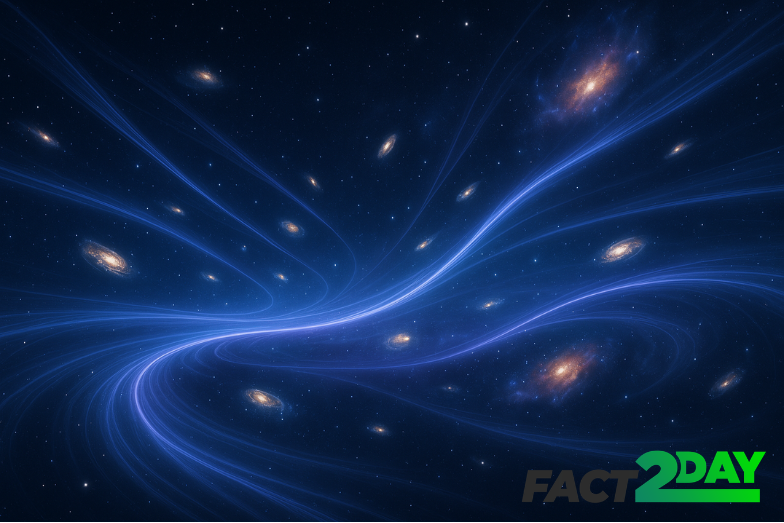
Dark energy is a mysterious force driving the accelerated expansion of the universe, making up about 68% of its total energy and challenging our understanding of physics and cosmology.
Have you ever heard of Cosmological Dark Energy? This mysterious force is responsible for accelerating the expansion of the universe, a phenomenon that still intrigues scientists and cosmology enthusiasts. Let’s explore together what makes this topic so fascinating and what mysteries remain unanswered.
What is cosmological dark energy?
Energia escura cosmológica is a mysterious form of energy that fills the entire universe and is believed to be responsible for its accelerated expansion. Unlike ordinary matter and energy, it does not emit, absorb, or reflect light, making it invisible and detectable only through its gravitational effects. Scientists estimate that energy escura comprises about 68% of the total energy content of the cosmos.
This enigmatic energy exerts a repulsive force, counteracting gravity’s pull and pushing galaxies apart at an increasing rate. The concept of energy escura was introduced to explain observations from the late 1990s, when astronomers discovered that distant galaxies were moving away faster than expected.
How energy escura affects the universe
Energy escura is linked to the cosmological constant originally proposed by Einstein. It creates a uniform pressure that drives the acceleration of cosmic expansion, influencing the large-scale structure and ultimate fate of the universe. Although its exact nature remains unknown, its presence challenges our understanding of physics and cosmology.
Researchers continue to study energy escura through various methods, including observing supernovae, the cosmic microwave background, and galaxy clusters. Unraveling the mysteries of this force could unlock new insights into the origins and future of everything we see in the sky.
How dark energy was discovered
The discovery of dark energy was a groundbreaking moment in cosmology. In the late 1990s, two independent teams of astronomers studied distant type Ia supernovae, which are powerful stellar explosions used as standard candles to measure cosmic distances. They expected to find that the universe’s expansion was slowing due to gravitational pull, but instead, they observed an unexpected acceleration.
These observations indicated that some unknown force was pushing galaxies apart at a faster rate. This led to the proposal of dark energy – an invisible, repulsive energy permeating all space. The discovery challenged existing models of the universe and earned the 2011 Nobel Prize in Physics for the scientists involved.
Methods used to uncover dark energy
The supernova observations were combined with data from the cosmic microwave background radiation and large-scale galaxy surveys. These multiple lines of evidence strengthened the case for an accelerating universe driven by dark energy. Cosmologists now use sophisticated telescopes and satellites to refine these measurements and explore the properties of this mysterious force.
This discovery has profoundly changed our understanding of the cosmos and opened new questions about the fundamental nature of space and time.
The role of dark energy in the expansion of the universe
Dark energy plays a critical role in the expansion of the universe. It is an unseen force that works against gravity, pushing galaxies away from each other and causing the expansion to speed up over time. Without dark energy, the gravitational pull of matter would slow down the universe’s growth.
The acceleration phenomenon
Observations show that the universe’s expansion is not just continuing but accelerating. This acceleration suggests that dark energy makes up about 68% of the total energy in the cosmos. It creates a pressure that acts uniformly throughout space, driving this rapid expansion.
As the universe grows, dark energy’s effect becomes more dominant, influencing the large-scale structure and future evolution of all cosmic objects. Scientists study this force through measures like supernova brightness and cosmic microwave background radiation.
Understanding dark energy helps us grasp why galaxies move faster apart, and it shapes theories about the ultimate fate of the universe, whether it will expand forever or change in unknown ways.
Difference between dark energy and dark matter
Dark energy and dark matter are two mysterious components that shape our universe, but they have very different properties and effects. Dark matter is a form of matter that does not emit light or energy, making it invisible, but it has mass and exerts gravitational pull. This helps hold galaxies together and influences their rotation.
Distinguishing features
In contrast, dark energy is an unknown force that causes the universe to expand at an accelerating rate. Unlike dark matter, it does not cluster or form structures but is spread uniformly throughout space. While dark matter attracts, dark energy repels.
Dark matter makes up about 27% of the universe’s mass-energy content, whereas dark energy comprises roughly 68%. Ordinary matter, which forms stars, planets, and living things, accounts for only about 5% of the cosmos.
Understanding the difference between these two helps scientists explain cosmic behavior, from galaxy formation to the universe’s future evolution.
Main theories about dark energy
Several theories attempt to explain the nature of dark energy, each offering different insights into its mysterious properties. One prominent idea is the cosmological constant, proposed by Einstein, which treats dark energy as a constant energy density filling space uniformly. This simplest model fits many observations but raises questions about why its value is so small yet non-zero.
Dynamic dark energy models
Another set of theories suggests that dark energy changes over time. These include quintessence, where a dynamic field slowly evolves and affects the universe’s expansion rate. Unlike the cosmological constant, quintessence can vary across space and time, offering a rich framework to explore.
Other theories involve modifications to general relativity, proposing that our understanding of gravity might need adjustment at cosmic scales. These modified gravity models aim to explain cosmic acceleration without invoking a new energy component.
Experimental and observational advances are needed to test these ideas and narrow down the true nature of dark energy, making this an exciting frontier in modern cosmology.
How we measure dark energy in the cosmos
Measuring dark energy in the cosmos is challenging because it does not emit or absorb light. Scientists rely on indirect methods, such as observing the universe’s expansion through distant celestial objects and cosmic background radiation.
Standard candles and redshift
One key approach uses type Ia supernovae as standard candles. These explosions have known brightness, so by measuring their apparent brightness, astronomers can estimate their distance. Comparing these distances with their redshifts—the stretching of light wavelengths due to cosmic expansion—helps reveal how fast the universe is expanding.
Cosmic microwave background and galaxy surveys
The cosmic microwave background (CMB) radiation provides a snapshot of the early universe. Detailed measurements of CMB fluctuations help determine the universe’s composition and geometry. Large-scale galaxy surveys also map the distribution of galaxies, revealing how structures grow under the influence of dark energy.
Combining data from these methods allows scientists to estimate the amount and behavior of dark energy accurately, advancing our understanding of its role in cosmic expansion.
Impact of dark energy on galaxy formation
Dark energy significantly influences the formation and evolution of galaxies by affecting the universe’s expansion rate. As dark energy pushes galaxies away from each other, it alters the gravitational forces responsible for pulling matter together to form galaxies.
Impact on galaxy clustering
This accelerating expansion reduces the ability of gravity to cluster matter efficiently. As a result, the large-scale structures, such as clusters and superclusters of galaxies, grow more slowly than they would in a universe without dark energy.
Moreover, dark energy affects the timeline of galaxy formation. Early in the universe, matter dominated the expansion, allowing galaxies to form and evolve. But as dark energy became dominant, its repulsive effect began to slow the growth of these structures.
Understanding the role of dark energy in galaxy formation helps scientists piece together the cosmic puzzle of how the universe’s vast and complex structures came to be.
The relationship between dark energy and the fate of the universe
The relationship between dark energy and the fate of the universe is crucial to understanding what will happen in the distant future. Dark energy drives the accelerated expansion of space, and its behavior influences whether the universe will keep expanding forever or experience a different end.
Possible destiny scenarios
If dark energy remains constant, as suggested by the cosmological constant theory, the universe will continue to expand at an accelerating pace, leading to a cold, dark, and empty cosmos often called the “Big Freeze”.
Another possibility involves dynamic dark energy models, where the force changes over time. This could cause the expansion to slow down or even reverse, leading to a “Big Crunch”, where the universe collapses back in on itself.
Some theories explore a “Big Rip” scenario, where dark energy grows stronger and eventually tears apart galaxies, stars, planets, and even atoms.
Studying dark energy is vital to predicting the universe’s fate and understanding the fundamental laws governing space and time.
Recent experiments and observations on dark energy
Recent experiments and observations have greatly advanced our understanding of dark energy. Scientists use various tools like space telescopes, supernova surveys, and cosmic microwave background (CMB) measurements to study its properties and effects.
Notable observations
One key observation comes from the Dark Energy Survey (DES), which maps hundreds of millions of galaxies to analyze how cosmic structures evolve. It helps tighten constraints on how dark energy influences the universe’s expansion.
The Euclid mission, launched by the European Space Agency, aims to explore dark energy by observing billions of galaxies and measuring their shapes and distances. This mission provides detailed information about cosmic acceleration.
Ground-based telescopes and supernova studies
Ground-based telescopes like the Vera Rubin Observatory also monitor supernovae and galaxy distributions, refining measurements of expansion rates and dark energy’s role. Recent data support the accelerating universe model but also hint at possible tensions that could point to new physics.
These cutting-edge observations and experiments continue to shape cosmology, offering hope for unraveling the true nature of dark energy.
How dark energy affects our understanding of physics
Dark energy challenges our current understanding of physics by introducing phenomena that cannot be explained by existing theories. It acts as a mysterious force causing the universe to expand faster, which contradicts traditional models based on gravity alone.
Impact on physics theories
The discovery of dark energy has pushed physicists to explore extensions to Einstein’s theory of general relativity. They investigate whether modifications to gravity at large scales could explain cosmic acceleration without needing a new energy component.
Dark energy also raises questions about the fundamental nature of space and time. It suggests that vacuum energy, a concept from quantum mechanics, might have a measurable effect on the cosmos, linking quantum physics with cosmology in unexpected ways.
Efforts to unify general relativity and quantum mechanics, possibly through theories like string theory, are partially motivated by the puzzle of dark energy. Understanding this force could lead to new physics that revolutionizes our grasp of the universe.
Implications of dark energy for modern cosmology
Dark energy has profound implications for modern cosmology, influencing how scientists understand the universe’s structure, evolution, and ultimate fate. Its discovery shifted the standard cosmological model to include a new form of energy that dominates the cosmos.
Changes to the cosmological model
Dark energy requires the inclusion of a cosmological constant or a dynamic field in Einstein’s equations, modifying predictions about cosmic expansion and structure formation. It explains why the universe’s expansion is accelerating, which was unexpected based on earlier models.
The presence of dark energy impacts estimates of the universe’s age, size, and composition. It forces cosmologists to revisit theories about the Big Bang and the growth of cosmic structures.
Driving new research directions
Dark energy prompts investigations into new physics beyond the standard model, including attempts to unify quantum mechanics with gravity. It also opens up questions about the nature of vacuum energy and the interplay between fundamental forces.
Understanding dark energy remains a central quest in cosmology, as it shapes our view of the universe and challenges physicists to rethink fundamental concepts about space, time, and matter.
What dark energy can reveal about the origin of the universe
Dark energy could hold key insights into the origin of the universe. Its mysterious nature challenges existing cosmological theories and might reveal unknown aspects of the universe’s birth and early expansion.
Links to the Big Bang and inflation
Some theories suggest that dark energy is related to the energy that drove cosmic inflation, a brief, rapid expansion of space just after the Big Bang. Understanding dark energy could help explain why the universe grew so quickly in its earliest moments.
Dark energy might also provide clues about the vacuum energy of space—the energy present even in empty space. This could connect quantum physics with cosmology, offering insights into how the universe emerged from nothing.
Studying dark energy helps physicists explore questions about the fundamental forces and particles that shaped the cosmos, potentially unveiling new physics that explains the universe’s origin and its continuing evolution.
Current challenges in studying dark energy
The study of dark energy faces many challenges due to its elusive nature. Since dark energy does not emit, absorb, or reflect light, researchers must rely on indirect observations and complex models to understand it.
Measurement difficulties
Accurately measuring the effects of dark energy requires precise observations of distant supernovae, galaxy clusters, and the cosmic microwave background. These measurements are sensitive to errors and require advanced technology and long-term data collection.
Theoretical challenges also exist. Scientists struggle to reconcile dark energy with existing physics frameworks like general relativity and quantum mechanics. Determining whether dark energy is a constant or a dynamic field remains uncertain.
Future research obstacles
Developing better instruments and missions, such as space telescopes and large-scale surveys, is crucial but expensive and technically demanding. Collaborations across institutions and countries are necessary to push this frontier.
Overcoming these challenges is essential for unveiling the nature of dark energy and its role in the universe.
Future missions and technologies to investigate dark energy
Future missions and advanced technologies are essential to unlock the secrets of dark energy. New space telescopes and ground-based observatories will provide more precise data to understand this mysterious force shaping the universe.
Upcoming space missions
The Euclid satellite, launched by the European Space Agency, is designed to map the geometry of the dark universe by observing billions of galaxies. Its goal is to measure the acceleration of cosmic expansion with unprecedented accuracy.
NASA’s Nancy Grace Roman Space Telescope will also contribute by surveying large areas of the sky, focusing on supernovae and galaxy clustering to study dark energy’s effects.
Innovative technologies
Ground-based facilities like the Vera C. Rubin Observatory will conduct wide-field surveys to observe millions of distant galaxies. These observations will help scientists refine dark energy models.
Advances in instrumentation, data processing, and machine learning are vital for analyzing vast datasets and detecting subtle signals related to dark energy.
Together, these missions and technologies will deepen our understanding of dark energy, potentially revolutionizing cosmology.
Understanding Dark Energy Is Key to Unlocking the Universe’s Secrets
Dark energy continues to be one of the greatest mysteries in modern science. It shapes the expansion and future of the cosmos in ways we are just beginning to understand.
Thanks to advanced technology and upcoming missions, scientists are making steady progress in studying this invisible force. Each discovery brings us closer to unveiling how dark energy works and its role in our universe.
As research moves forward, dark energy could redefine our understanding of physics and the cosmos. Staying curious and supporting scientific exploration will help us uncover the universe’s deepest secrets.