The Invisible Universe: The Cutting-Edge Experiments Trying to Directly Detect Dark Matter
Explore the forefront of science with Dark Matter Direct Detection, uncovering the secrets of the cosmos's mysterious invisible mass.
Imagine a courtroom filled with the usual cast of judges, jurors, and lawyers, but with a surprising twist: the defendant is an animal. This strange but true practice of animal trials was common in medieval Europe, where creatures were put on legal trial for various offenses.
From pigs accused of murder to insects blamed for ruining crops, these cases were often serious and followed legal procedures similar to those for humans. Animals were given lawyers, witnesses testified, and verdicts were sometimes appealed. This strange tradition reveals much about medieval ideas of justice, responsibility, and the role of animals in society.
Unlike today, animals were seen as moral beings who could commit crimes and be held accountable under the law. While it may seem odd now, these trials show how closely linked law and religion were in the past and challenge us to think about how ideas of guilt and innocence have changed over time.
These stories remind us that our concepts of law and fairness have developed through centuries of belief and culture, sometimes in surprising ways.
Consider for a moment the elusive nature of Dark Matter Direct Detection. What does it truly mean to catch a glimpse of something invisible, and why does it challenge our understanding of the universe so profoundly? Join me as we explore this cutting-edge frontier in physics.
What is dark matter and why is it important?
Dark matter is a type of matter that does not emit, absorb, or reflect light, making it invisible to current telescopes. It is estimated to make up about 27% of the universe’s mass-energy, playing a critical role in shaping the structure of galaxies and the cosmos. Scientists believe dark matter explains why galaxies rotate faster than expected and why they hold together instead of flying apart.
Understanding dark matter is important because it fills in many gaps in our knowledge of the universe. Without it, the laws of gravity and motion would fail to explain the behavior of galaxies and cosmic structures. Dark matter also influences the formation of galaxies and the large-scale structure of the universe, affecting everything from galaxy clusters to the cosmic web.
Though invisible and mysterious, dark matter’s gravitational effects provide strong evidence for its existence. Discovering its true nature could unlock new physics beyond the Standard Model and deepen our understanding of the universe’s origin and fate.
How does direct detection differ from other detection methods?
Dark matter can be studied through several methods, but direct detection stands out by aiming to observe dark matter particles interacting with regular matter inside detectors here on Earth. Unlike indirect detection, which searches for signals from dark matter annihilations or decays in space, direct detection looks for rare collisions between dark matter particles and nuclei within ultra-sensitive detectors.
Indirect detection methods rely on observing secondary particles such as gamma rays, neutrinos, or cosmic rays that could be produced when dark matter particles collide or decay. These methods examine large regions of space for unusual signals, which can be challenging due to background noise and uncertainties about the source.
Another approach, collider experiments, attempt to produce dark matter particles by smashing high-energy particles together in accelerators like the Large Hadron Collider. While this can provide valuable information, it does not directly observe dark matter in the universe’s natural state.
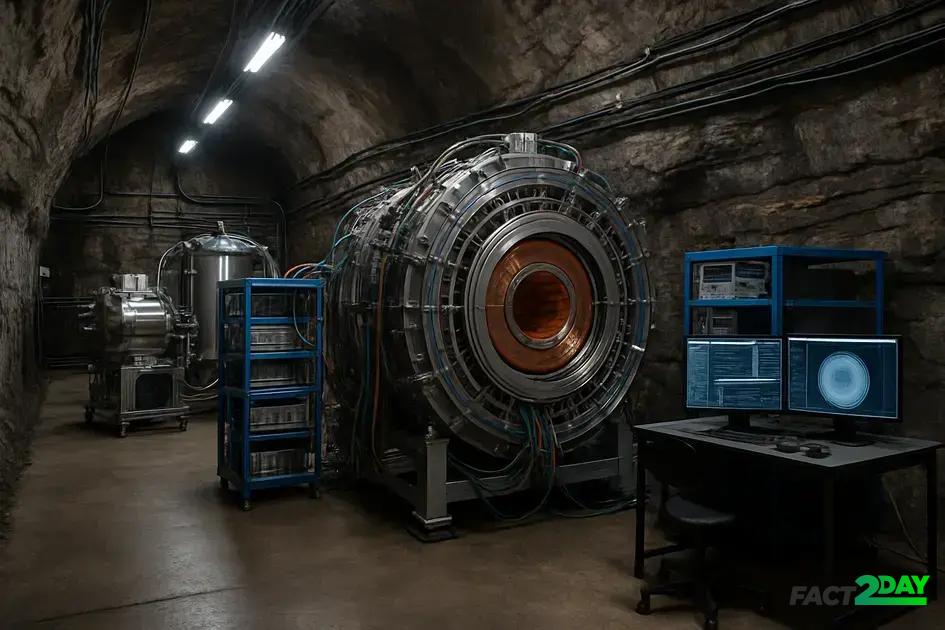
Direct detection experiments, in contrast, use extremely sensitive instruments placed deep underground to shield from cosmic rays and other background radiation. These detectors are designed to catch the faint energy released when a passing dark matter particle gently hits an atom in the detector material. Technologies such as cryogenic detectors, liquid xenon tanks, and bubble chambers allow scientists to distinguish these rare events from noise.
Because direct detection works locally and relies on interaction signals, it provides a powerful and complementary way to study dark matter, helping confirm its existence and properties alongside other methods.
Key technologies used in direct detection experiments
Direct detection experiments use several advanced technologies to identify the rare interactions between dark matter particles and atomic nuclei. These technologies must be incredibly sensitive and operate in controlled environments to filter out background noise and false signals.
Cryogenic Detectors
These detectors work at extremely low temperatures, close to absolute zero, to detect tiny energy deposits caused by dark matter collisions. The low temperatures reduce thermal noise, allowing the detector to measure minute vibrations or ionization signals. Examples include germanium or silicon crystals cooled to detect phonons generated by particle interactions.
Liquid Xenon Time Projection Chambers (TPCs)
Liquid xenon is a popular detection medium due to its high density and ability to scintillate when hit by particles. TPCs detect both the light and ionization electrons created during a collision, providing precise 3D positioning and energy measurements. This dual signal helps differentiate potential dark matter events from background radiation.
Bubble Chambers and Superheated Droplet Detectors
These detectors contain superheated liquids that form bubbles when a particle deposits enough energy. They are sensitive to nuclear recoils caused by dark matter but less responsive to other types of background radiation, improving signal clarity.
Scintillators and Photodetectors
Scintillating materials emit light when struck by particles. Photodetectors then convert this light into electrical signals that can be analyzed. Combining different scintillators enhances the ability to reject background and improve detection sensitivity.
Shielding and Background Reduction are also vital technologies in these experiments. Detectors are housed deep underground to shield them from cosmic rays, and multiple layers of material reduce ambient radioactivity, enhancing the chances of spotting true dark matter interactions.
Together, these technologies form a sophisticated network allowing physicists to detect potential dark matter particles with unprecedented sensitivity and accuracy.
Major international experiments dedicated to dark matter detection
Several major international experiments are dedicated to the direct detection of dark matter, using some of the most advanced technologies in particle physics. These collaborations bring together scientists from around the world to improve the sensitivity and accuracy of dark matter searches.
LUX-ZEPLIN (LZ) Experiment
The LZ experiment, located deep underground in the Sanford Underground Research Facility in the United States, uses a large tank filled with liquid xenon to detect potential dark matter particle interactions. It is designed to be one of the most sensitive detectors, aiming to catch weakly interacting massive particles (WIMPs), a leading dark matter candidate.
XENONnT
XENONnT is situated in the Gran Sasso National Laboratory in Italy. It also uses a liquid xenon time projection chamber, with a focus on reducing background signals to spot rare dark matter events. The experiment builds on the success of previous XENON detectors.
PandaX
Located in the China Jinping Underground Laboratory, PandaX uses similar liquid xenon technology to search for dark matter. Its deep underground position helps shield it from cosmic rays, improving its detection capabilities.
SuperCDMS
The Super Cryogenic Dark Matter Search experiment focuses on using supercooled solid-state detectors made from germanium and silicon. Situated in the SNOLAB in Canada, it aims to detect dark matter by measuring minute vibrations from particle interactions.
These international efforts highlight the global commitment to uncovering the mysteries of dark matter, combining technology, expertise, and resources to push the boundaries of modern physics.
Challenges in detecting dark matter particles
Detecting dark matter particles presents several significant challenges, primarily because these particles interact with normal matter very weakly. This makes any interaction extremely rare and difficult to observe directly.
Extremely Low Interaction Rates
Dark matter particles rarely collide with atoms, so experiments must be highly sensitive and capable of detecting incredibly faint signals. Capturing such rare events requires long observation times and large detector volumes.
Background Noise and False Signals
Experiments must differentiate potential dark matter signals from background radiation like cosmic rays, natural radioactivity, and other particle interactions. To reduce noise, detectors are often placed deep underground and shielded with multiple layers of protective materials.
Detector Sensitivity and Calibration
Maintaining and calibrating detectors to ensure accurate measurements is complex. Sensitivity must be high enough to detect tiny energy deposits, while false positives must be minimized through careful design and analysis.
Unknown Particle Properties
Since dark matter’s exact properties are unclear, detectors must be designed to identify a range of possible particle masses and interaction types. This uncertainty complicates the design and interpretation of experiments.
Technological Limitations
Current technologies may not be sufficient to detect all potential dark matter candidates. Researchers continuously push the boundaries, developing new materials and methods to enhance detection capabilities.
Together, these challenges highlight the complexity of the quest to directly detect dark matter, requiring advanced technology, innovative methods, and persistent effort.
The role of cryogenic detectors in direct detection
Cryogenic detectors play a crucial role in the direct detection of dark matter by measuring tiny energy deposits from rare particle interactions. These detectors operate at temperatures near absolute zero to reduce thermal noise, which allows them to detect extremely small signals that would be impossible to observe at higher temperatures.
How Cryogenic Detectors Work
They use materials like germanium or silicon crystals cooled to a few millikelvin. When a dark matter particle collides with an atomic nucleus, it transfers energy, producing vibrations called phonons. Cryogenic detectors detect these phonons as well as ionization produced during the interaction.
Advantages of Cryogenic Detection
Operating at such low temperatures enhances signal clarity and sensitivity, making these detectors some of the most precise tools in the field. They can measure energy deposits with great accuracy and distinguish between different types of particles, helping reduce background noise.
Applications and Experiments
Experiments like the Super Cryogenic Dark Matter Search (SuperCDMS) utilize cryogenic detectors deep underground to maximize their sensitivity. The extreme cold environment is maintained using advanced refrigeration systems, ensuring that tiny energy changes can be detected.
The combination of phonon and ionization measurements enables researchers to better identify potential dark matter interactions, pushing the boundaries of our knowledge about the invisible universe.
Using underground labs to shield experiments from noise
Underground laboratories are essential for dark matter direct detection because they provide shielding from cosmic rays and other sources of background noise that could interfere with sensitive measurements. Placing detectors deep beneath the Earth’s surface helps create a quiet environment where faint signals from dark matter interactions can be observed more clearly.
Why Underground Labs Are Needed
The Earth’s surface is constantly bombarded by cosmic rays — high-energy particles from space — which create background radiation that can mimic or hide the rare events scientists are trying to detect. By situating detectors deep underground, rock layers act as a natural shield, drastically reducing cosmic ray interference.
Examples of Underground Facilities
Some of the world’s leading underground labs include the Sanford Underground Research Facility in the USA, the Gran Sasso National Laboratory in Italy, and the China Jinping Underground Laboratory. These locations offer depths ranging from hundreds to thousands of meters below ground.
Additional Shielding and Noise Reduction
Besides natural rock shielding, experiments often use layers of lead, polyethylene, or water tanks to absorb remaining radiation. Active veto systems may also detect and ignore background events, ensuring only potential dark matter signals are recorded.
Maintaining low background noise is critical because dark matter interactions are expected to be extremely rare and subtle. Underground labs provide the quietest possible surroundings to enhance detector sensitivity and improve the chances of making groundbreaking discoveries.
Recent breakthroughs and findings in direct detection
Recent breakthroughs in dark matter direct detection have brought scientists closer to understanding this mysterious substance. New generation experiments with improved sensitivity are now able to detect signals previously too weak to observe.
Improved Detector Sensitivity
Technological advances, such as larger liquid xenon detectors and ultra-cold cryogenic sensors, have increased the ability to spot faint interactions. This has reduced noise and background interference, allowing clearer detection of potential dark matter events.
New Limits on Dark Matter Properties
Experiments like XENONnT and LUX-ZEPLIN have placed stronger constraints on the mass and interaction strength of dark matter particles. These limits help narrow down the range of possible dark matter candidates.
Potential Signals and Anomalies
Occasional unusual events in detectors have sparked interest but require further investigation. While none have been confirmed as dark matter yet, they drive ongoing research and new experimental designs.
Cross-Experiment Collaboration
Collaborations between different international experiments allow cross-checking of results and enhance the reliability of findings. Sharing data helps refine models and experimental methods.
These breakthroughs reflect continuous progress in the challenging search for dark matter, offering hope that direct detection may soon become a reality.
Theoretical implications of detecting dark matter
The detection of dark matter would have profound theoretical implications across physics and cosmology. It would confirm that dark matter is made of particles beyond the Standard Model, opening a new field of particle physics that explains the universe’s missing mass.
New Physics Beyond the Standard Model
Direct detection would suggest the existence of particles like WIMPs (Weakly Interacting Massive Particles) or other exotic candidates. This discovery could help unify gravity with quantum mechanics and point to new fundamental forces or symmetries.
Impact on Cosmology
Detecting dark matter particles would provide insights into the universe’s formation, structure, and evolution. It would help explain how galaxies formed and why the cosmic web is shaped the way it is.
Revising Models of the Universe
Current cosmological models rely on assumptions about dark matter’s nature. Confirming its particle properties would refine simulations and predictions about large-scale cosmic phenomena.
Advancing Technology and Research
The breakthrough would stimulate new experimental methods and technology development, influencing fields beyond astrophysics, such as materials science and quantum computing.
The discovery of dark matter particles would be a paradigm shift, reshaping scientific understanding of the universe and inspiring future research directions.
Future prospects and upcoming experiments
The future of dark matter direct detection looks promising as new experiments push the boundaries of technology and sensitivity. The next generation of detectors will be larger and more precise, designed to probe deeper into the unknown.
Upcoming Experiments
Projects like the LUX-ZEPLIN (LZ) and DARWIN detectors aim to increase target mass and reduce background noise, enhancing the chances of detecting faint dark matter interactions. These experiments will use ultra-pure materials and advanced shielding techniques.
Expanding Detection Methods
Besides traditional liquid xenon detectors, researchers are exploring novel materials and detection technologies such as superfluid helium and graphene-based sensors. These innovations open new pathways for detecting lighter or less interactive dark matter particles.
Collaborative Efforts
International collaborations are growing, pooling resources and expertise to build larger underground laboratories and share data effectively. This teamwork speeds up progress and helps cross-check findings.
Potential Impact
Future breakthroughs in detecting dark matter could revolutionize our understanding of physics and cosmology, possibly unveiling new particles and forces.
With advancing technology and global scientific cooperation, the quest to directly detect dark matter is entering an exciting phase filled with discovery potential.
How direct detection shapes our understanding of the universe
Direct detection of dark matter deeply influences how we understand the universe. By observing dark matter particles, scientists gain crucial insights into the unseen material that forms a large part of the cosmos.
Unveiling the Hidden Mass
Dark matter does not emit light, so it cannot be seen directly. However, its gravitational effects affect galaxy formation and cosmic structure. Direct detection confirms its existence and properties, explaining phenomena that visible matter alone cannot.
Refining Cosmological Models
Finding direct evidence for dark matter helps improve models of the universe’s evolution. It allows scientists to make more accurate predictions about how galaxies grow, how clusters form, and how the universe will change over time.
Testing Fundamental Physics
Direct detection probes physics beyond the Standard Model, potentially revealing new particles or forces. This could challenge or expand current theories, leading to breakthroughs in particle physics and cosmology.
Connecting Micro and Macro Worlds
Detecting dark matter particles links microscopic quantum phenomena to vast cosmic structures. This connection helps unify understanding from the smallest scales to the largest, bridging gaps in knowledge.
Through direct detection, we edge closer to solving mysteries about the universe’s composition and the forces shaping it, deepening our grasp of reality itself.
Connecting dark matter detection to cosmology and astrophysics
Detecting dark matter is deeply linked to the fields of cosmology and astrophysics, as these particles play a key role in the universe’s structure and evolution. Understanding dark matter helps scientists explain how galaxies and large-scale cosmic formations came to be.
The Cosmic Web and Dark Matter
Dark matter acts as a cosmic scaffold, influencing the distribution of galaxies and galaxy clusters by its gravitational pull. This creates the cosmic web, a vast network of filaments and voids observable through astrophysical surveys.
Impact on Galaxy Formation
Dark matter’s gravity affects how galaxies form and maintain their shape. Without dark matter, stars in galaxies would not orbit as observed. Studying dark matter detection aids in refining models of galaxy behavior and dynamics.
Relation to Cosmic Microwave Background
The radiation leftover from the Big Bang, known as the cosmic microwave background, carries imprints influenced by dark matter. Direct detection helps correlate these patterns with the properties of dark matter particles.
Enhancing Astrophysical Simulations
Knowing dark matter’s properties allows scientists to create more accurate simulations of the universe’s past and future. This bridges particle physics with large-scale cosmic observations.
Integrating direct detection results with cosmology and astrophysics paves the way for a more complete understanding of the universe across all scales.
Understanding the Quest for Dark Matter
Dark matter remains one of the biggest mysteries in science, shaping how we view the universe. Direct detection experiments are crucial to uncovering its true nature.
Through advanced technology and global collaboration, scientists are making steady progress in detecting these elusive particles. Each breakthrough brings us closer to solving cosmic puzzles and refining our understanding of the universe.
As research continues, the discovery of dark matter could transform physics, cosmology, and our grasp of reality itself. The invisible universe is waiting to be revealed.