The Hidden Message: History’s Most Brilliant Secret Codes and Cryptographies
Criptografia histórica revela os códigos secretos que moldaram a comunicação e a guerra ao longo do tempo. Descubra seus mistérios fascinantes.
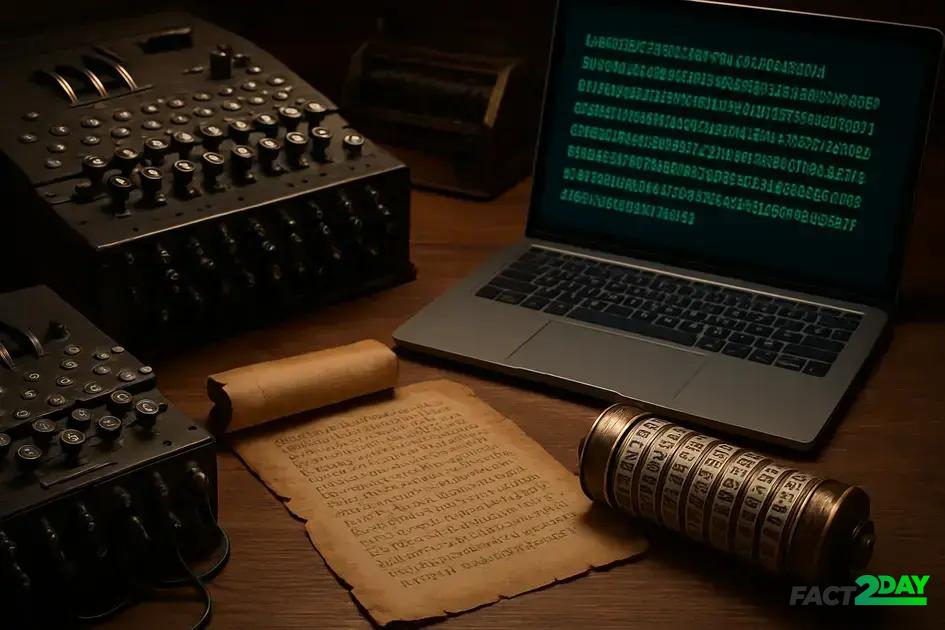
Historical cryptography refers to the development and use of secret codes and encryption methods throughout history, from ancient ciphers like the Caesar cipher to advanced machines like Enigma, playing a vital role in secure communication and espionage.
Have you ever stopped to think about how historical cryptography hid vital messages over the centuries? From antiquity to the modern era, secret codes have shaped decisions and destinies. Let’s explore these enigmas together.
The first codes and encrypted messages
Throughout history, civilizations have created some of the first codes and ciphered messages to protect important information. One of the earliest examples is the Caesar cipher, used by Julius Caesar to send secret messages to his generals by shifting letters of the alphabet. This simple substitution method made it difficult for enemies to understand the content without knowing the key.
Besides the Roman Empire, other cultures developed unique methods. For example, the ancient Egyptians used hieroglyphics with hidden meanings, and during the Middle Ages, monks would use complex patterns and symbol substitutions to secure religious texts. These early techniques show how humans have always sought ways to communicate secretly.
These primitive ciphers laid the groundwork for more advanced cryptographic methods that followed, combining creativity with the need for security. They also highlight the importance of confidentiality, whether in war, politics, or personal communication.
the evolution of cryptography methods
The evolution of cryptography methods reflects humanity’s growing need for secure communication. Starting from simple substitution ciphers like the Caesar cipher, methods quickly became more complex to resist enemy decryption. During the Renaissance, the Vigenère cipher introduced polyalphabetic encryption, which used multiple alphabets to make codes harder to crack.
In the 20th century, mechanical devices such as the Enigma machine revolutionized cryptography by automating encryption with complex rotor systems. This allowed messages to be encoded in ways impossible to decode without knowing the machine’s settings.
Modern cryptography uses mathematical algorithms and computer technology to create advanced encryption standards. Public key cryptography introduced a key pair system that separates encryption and decryption keys, enabling safe digital communication over the internet. These advances illustrate the continuous effort to stay ahead of codebreakers and protect sensitive data worldwide.
famous cases of decryption and espionage
Throughout history, there have been famous cases of codebreaking and espionage that changed the outcome of wars and shaped political events. One of the most notable examples is the Allied efforts to decrypt the German Enigma machine during World War II. The work at Bletchley Park, led by Alan Turing, cracked the complex cipher, allowing the Allies to intercept crucial military communications.
Another significant case involves the Zimmermann Telegram, a secret message sent by Germany to Mexico during World War I, proposing a military alliance. British cryptographers intercepted and decoded it, influencing the United States to join the war.
Espionage and cryptanalysis often go hand in hand. Spies have used ciphers to send secret information, while codebreakers strive to uncover these hidden messages. These dramatic episodes highlight the critical role of cryptography in intelligence and warfare history.
Understanding the power of historical cryptography
Exploring famous cases of codebreaking and espionage shows how secret messages have shaped history. These stories remind us of the constant battle between those who create codes and those who try to break them.
Cryptography has always played a crucial role in protecting information and influencing outcomes. By learning from these historic examples, we appreciate the importance of secure communication in today’s world.
As technology grows, keeping our data safe remains vital, just as it was centuries ago. So, the legacy of cryptography continues to teach us the value of secrecy and intelligence.