Professions of the Past: The Strangest and Most Forgotten Jobs That Shaped History
Profissionais desaparecidos revelam ofícios curiosos e esquecidos que influenciaram a história de formas surpreendentes e pouco conhecidas.
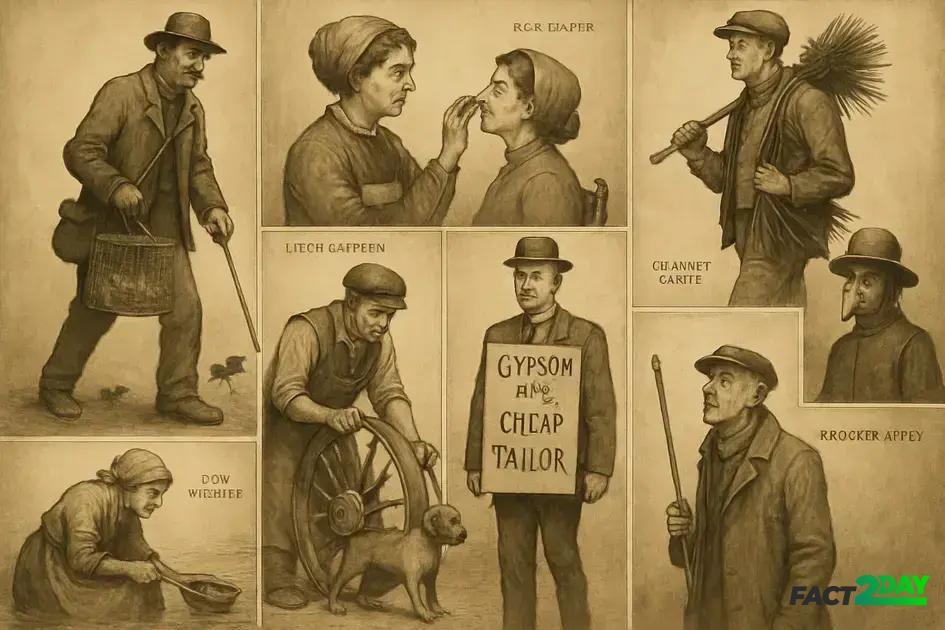
Disappearing professionals are occupations that have been extinguished by technological advances, economic, and social changes, leaving a cultural legacy that reveals the evolution of work and society throughout history.
Have you ever heard of disappearing professionals? These are those curious occupations that time has taken away, but which reveal a lot about our past and culture. How about discovering some of these professions and their history?
Occupations that have disappeared over time
Throughout history, many occupations have vanished due to technological progress, social changes, and evolving economies. Some jobs that once were common are now lost to time, leaving behind only stories and artifacts. For example, the role of a knocker-upper involved waking people up before alarm clocks became widespread, using a long stick to tap on their windows in industrial cities.
Another disappearing profession was that of the lamplighter, who manually lit street lamps every evening and extinguished them in the morning. With the invention of electric street lighting, this occupation became obsolete. Similarly, the town crier once played a vital role in communication, publicly announcing news before newspapers and modern media existed.
These disappeared jobs often give insight into the social dynamics and technological limits of their eras. Understanding these professions helps us appreciate how rapidly work environments can change and how human needs evolve with innovation.
why some jobs become obsolete
Jobs become obsolete for various reasons, most often due to advances in technology. Machines and software can perform tasks faster and more accurately than humans, replacing roles like typists and switchboard operators. As new inventions arise, they change the way industries operate, leading to less need for certain professions.
Economic shifts also play a key role. When industries decline or evolve, jobs tied to them fade away. For example, the decline of coal mining and the rise of renewable energy changed many employment opportunities.
Social and cultural changes influence job relevance too. Some roles lose importance as people’s lifestyles and needs evolve, such as the decrease in the demand for town criers once newspapers and radios became common.
Globalization and automation increase competition and efficiency, pushing companies to adapt and often eliminate positions that can be done more cheaply or quickly with technology or outsourcing.
Understanding the reasons behind job obsolescence helps workers and societies prepare for changes and seek new skills that align with the modern economy.
the cultural legacy of forgotten professions
The legacy of forgotten professions goes beyond mere jobs; it shapes culture and offers a window into the past. Many disappeared occupations have influenced traditions, language, and social structures. For example, the craft of the blacksmith was not just about making tools, but it was a community cornerstone, shaping the development of towns.
These lost jobs often inspired stories, folklore, and art. The town crier, for instance, is remembered in poems and plays, symbolizing the way information was shared before modern communication.
Preserving knowledge about these professions helps us understand historical lifestyles and values. Museums, festivals, and reenactments often celebrate these roles, keeping their memory alive and connecting us with our heritage.
Learning about forgotten jobs fosters appreciation for human ingenuity and the evolution of work. It also reminds us that every profession, no matter how small or strange it seems today, played a part in shaping our world.
Reflecting on the impact of forgotten professions
Exploring the world of forgotten jobs helps us connect with history and appreciate how work has evolved. These professions reveal much about past societies and their values.
By remembering and honoring these vanished roles, we gain insight into human creativity and cultural heritage. This awareness can inspire us as we think about the future of work and the changes still to come.